See the month your savings reach what a purchase needs, what owning would cost each month next to your rent, and the year owning pulls ahead — in today's dollars.
Open the demo →Savings
$
/mo
Home
/mo
$
%
%
yrs
Scenario
Assumptions
mo
%/yr
%/yr
%/yr
%
%/yr
%/yr
Ready to buyFeb 20336yr 4mo from now
Cash needed$125,660$40K saved · in today's dollars
Monthly cost of owning$3,553$1,153/mo over rent then
Getting there
Savings and cash needed
$0$50K$100K
Oct 2026Jun 2030Feb 2034
SavingsCash neededReady · Feb 2033
In today's dollars.
If more is saved each month
| Extra | Ready to buy | Sooner by |
|---|---|---|
| Current plan | Feb 2033 | — |
| +$500/mo | Mar 2031 | 1yr 11mo |
| +$1,000/mo | Mar 2030 | 2yr 11mo |
| +$2,000/mo | Feb 2029 | 4yr |
Once you own
Cost of renting vs buying
$0$100K$200K$300K
203320412048
OwningRenting
Renting costs less for all 15 years, on these assumptions.
No income taxes
No mortgage-interest deduction, and no tax on investment growth or on the gain from a sale. Property tax is counted.
No rate forecast
The rate typed holds for the whole term, even when buying later.
Retirement not counted
What saving for this does to retirement isn't modeled here.
These figures are estimates for planning, not investment, tax, or legal advice. Read the full disclaimer
In Taiga Finance
The same planner, on the savings you actually hold.
Tick the funds that count toward the house and the planner runs on their real balances, takes the monthly amount from your plan and the rent from the Plan lines you pick, and keeps the scenarios you save.
Join the waitlist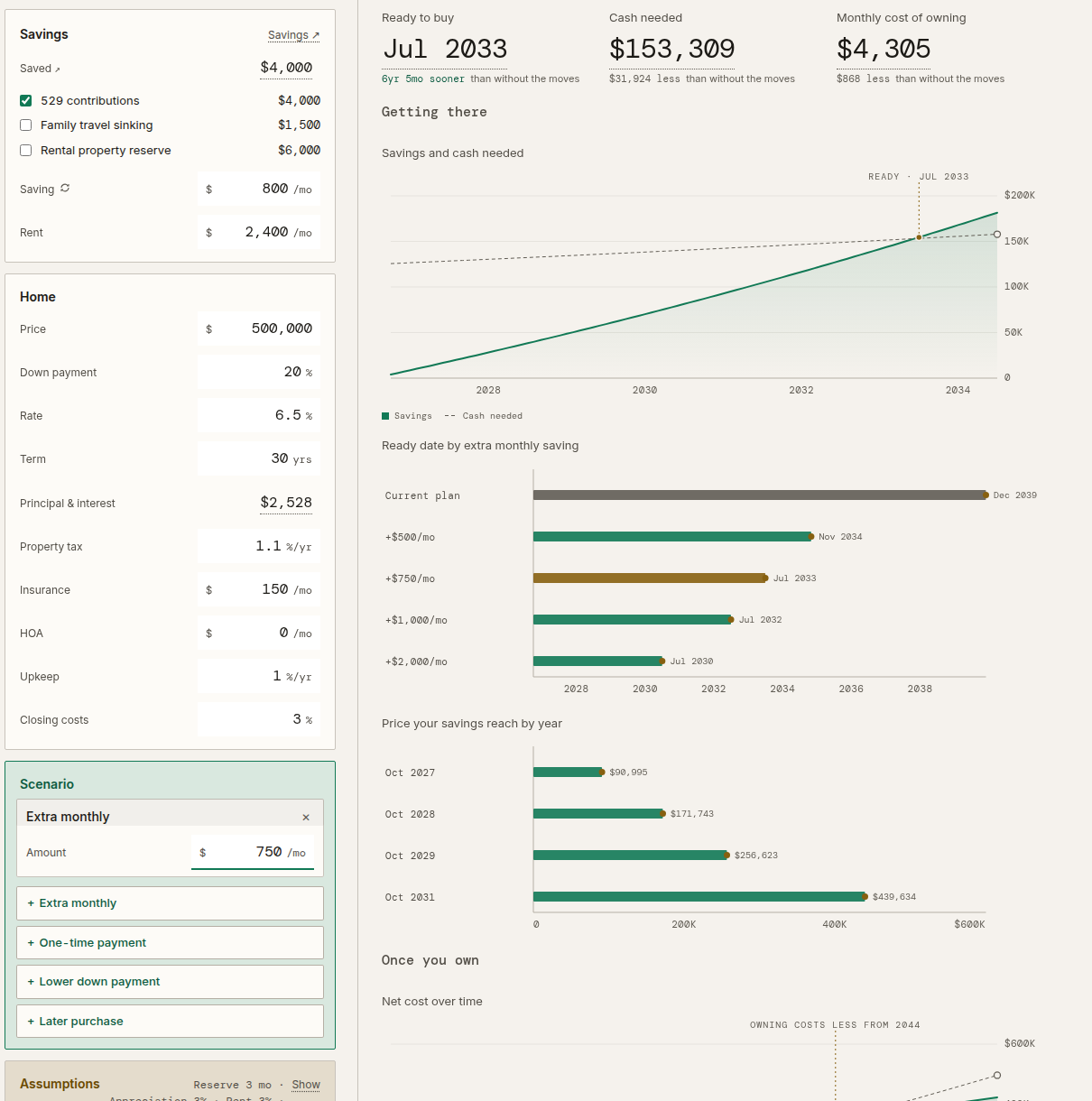
How this calculator works.
Two lines race each other month by month: your savings, which grow on what you add and the return you assume, and the cash a purchase needs, which rises with the price. The cash needed is the down payment and closing costs on that month's price plus a reserve of a few months of owning's cost. The ready month is the first month the savings line reaches the cash line. From that purchase the calculator then runs fifteen years of owning against fifteen years of renting: everything owning pays out less what a sale would give back, against the rent paid less what the down payment would have earned had it stayed invested. The clock inside is nominal; every figure comes back read in today's dollars.
Cash needed = P × (d + c) + N × Own(P) · Own(P) = P&I + tax + upkeep + insurance + HOA + PMI
P = the price that month · d = down payment share · c = closing cost share · N = months of reserve · Own(P) = owning's monthly cost at that price
A target that moves
The cash a purchase needs is mostly a share of the price, and the price keeps rising while you save. At 3% appreciation a $500,000 home costs about $603,000 when the example plan is ready, six years and four months out, in that month’s dollars. Read in today’s dollars, with inflation also at 3%, that is $500,000 again: the price kept pace with everything else, and the cash-needed line on the chart holds still at $125,660. Set appreciation above inflation and the line climbs, because the home is outrunning the dollar; set it below and the line falls. Saving faster still shortens the wait, since the savings grow on the return and the saving keeps pace with inflation inside the model.
What the reserve is for
The default keeps three months of owning’s cost in savings after closing. It is not part of the purchase; it is the cushion that keeps a first repair or a slow month from going on a card. At zero, the ready date is the earliest one the down payment and closing costs alone allow.
Owning’s monthly cost, in parts
Principal and interest come from the standard fixed-rate payment on the loan at the purchase price. Property tax and upkeep are yearly shares of the home’s value, divided by twelve. Insurance and HOA dues are flat monthly amounts in today’s dollars. PMI is charged under 20% down, at 0.5% a year of the original loan, until the balance amortizes to 80% of the purchase price; the model assumes no reappraisal. The Home card folds these behind their monthly sum at the price as typed; the Monthly cost of owning tile reads them at the price in the month you buy, in today’s dollars.
The four moves
An extra monthly amount adds to the saving every month. A one-time payment lands in the month you pick and is on file from then on. A lower down payment reduces the cash needed and raises the loan, and counts only when it is lower than the Home card’s figure. A later purchase sets the earliest month the calculator will look at; when the savings would have been ready later anyway, it says so. The table under the savings chart prices four flat extras on the plan without its moves, so its rows hold still while a scenario is edited.
Renting against owning
Both paths start at the purchase. Owning’s running total is the down payment and closing costs, then every month’s principal, interest, tax, insurance, HOA, upkeep and PMI; what a sale would give back, after the selling cost and the remaining loan, is subtracted from it. Renting’s running total is the rent, growing at the rent-growth rate, less the growth the down payment and closing costs earned at the return if renting had they stayed invested — its own rate, since a house fund’s yield is not what a renter would hold for fifteen years. The monthly difference between rent and owning’s cost is not invested on either side. Every outlay is read in the dollars of its own month and every year-end stock in the dollars of that year’s end, so a row sums dollars of one kind.
What it leaves out
Income taxes, on either side: no mortgage-interest deduction, and no tax on the investment growth or on a sale’s gain. The rate you type holds for the whole term even when the purchase is years away. Rents, prices and inflation move at one flat rate each. And what saving for a house does to saving for retirement isn’t in the picture.
Terms used here.
- Cash needed
- What a purchase takes up front: the down payment and closing costs on the price that month, plus a reserve of a set number of months of owning's cost kept in savings after closing.
- Ready month
- The first month, at or after any later-purchase date, in which the savings reach the cash needed at that month's price. The price keeps rising while you save, so the target moves.
- Today's dollars
- The unit every figure is shown in: a later month's amount divided by inflation to that month, so it reads as what a dollar buys today. The amounts you type are today's dollars too, and keep pace with inflation inside the model.
- Home price in reach
- The price whose cash needed equals what the savings hold in a given month, on the down payment, closing costs and reserve as set. Read off the savings chart at any month.
- Monthly cost of owning
- Principal and interest on the loan, property tax and upkeep as a share of the home's value, insurance, any HOA dues, and PMI while it applies.
- PMI
- Private mortgage insurance: a yearly charge on the loan while the balance is above 80% of the purchase price, so it applies under 20% down and stops once the loan amortizes to 80%.
- Equity if sold
- The home's value less the selling cost and the loan balance at that point: what a sale would hand back, and what owning's net cost is read against.
- Return if renting
- The yearly return, before inflation, on the down payment and closing costs a renter keeps invested instead of handing over at closing. Its own rate: a house fund's yield is the wrong instrument for a fifteen-year investment.
- Net cost
- Owning: everything paid out since closing less equity if sold. Renting: rent paid since the same date less the growth the down payment and closing costs would have earned at the return if renting. The breakeven is the first year owning's net is at or below renting's.
Asked often.
When the savings reach the cash the purchase needs, and that target moves: the down payment and closing costs are a share of the price, and the price rises at the appreciation rate you assume. The calculator searches month by month for the first month the savings line reaches the cash line and names it, or says the pace never gets there within fifty years.
The down payment, closing costs and a reserve. On a $500,000 home at 20% down with 3% closing costs that is $115,000 before the reserve; three months of owning's cost adds about $10,700 more. The calculator prices this at the month you would buy and reads it back in today's dollars, so the figure means what the same cash would mean now.
A purchase years out is paid in that year's dollars, which buy less. The model runs on the nominal clock — the price, the rent and the savings grow at the rates you set, and the mortgage payment is the fixed amount the loan sets — and then divides every result by inflation to its month, so a figure six years out and a figure today can be read side by side. With appreciation equal to inflation, the cash needed holds still on the chart; it climbs only where the price outruns inflation.
It depends on the price, the rent, how fast each grows, the return the down payment could earn elsewhere, and how long you stay. The calculator draws both net costs from the purchase for fifteen years and marks the first year owning's net cost drops below renting's, or says it never does on those assumptions. The return if renting sets much of it: at 8% the renter's kept cash grows enough that, on the example plan, renting costs less for all fifteen years.
A lower down payment needs less cash, so the ready month comes sooner. It also means a larger loan and a higher monthly payment, and under 20% down the model charges PMI until the loan amortizes to 80% of the purchase price. The Lower down payment move shows all three at once.
No. The calculator runs in your browser and nothing you type is sent anywhere. Inside Taiga Finance, the same planner runs on the savings funds you tick, takes the monthly amount from your plan and the rent from the Plan lines you pick, and keeps the scenarios you save.