See the combined result of extra payments, lump sums, refinances, or recasts on your payoff date and total interest.
Open the demo →Loan
$
%
yrs
$
Scenario
Paid offOct 2056
Remaining interest$510,178
$0$100K$200K$300K$400K
Oct 2026Oct 2041Oct 2056
Balance
$0$1K$2K
Oct 2026Oct 2041Oct 2056
PrincipalInterest
Mortgage payoff date by extra monthly payment
Principal and interest only
This schedule covers principal and interest only. Property taxes, insurance, HOA dues, escrow, and refinance closing costs aren't in it.
These figures are estimates for planning, not investment, tax, or legal advice. Read the full disclaimer
In Taiga Finance
The same planner, on the mortgage you actually hold.
Connect or add the mortgage and the planner runs on its real balance, rate and payment, stays current as the balance falls, and keeps the scenarios you save.
Join the waitlist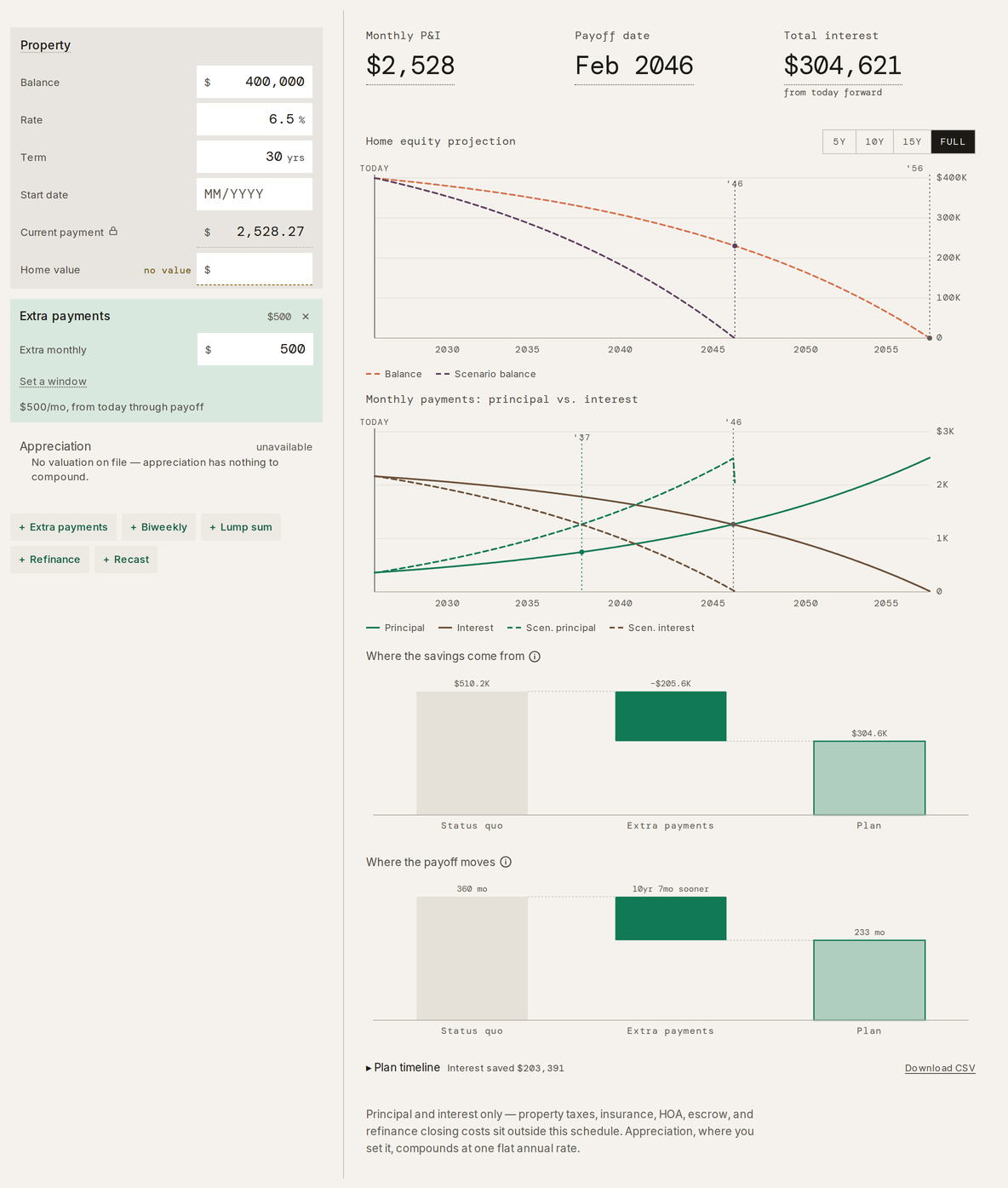
How this calculator works.
A fixed-rate mortgage is paid down on a schedule: each month, interest accrues on the balance, the rest of the payment reduces principal, and the balance falls until it reaches zero. Extra principal skips future interest on the dollars it retires, which is why a small monthly addition can move the payoff date by years. The monthly payment for a level-payment loan is the standard amortization formula:
M = P × r(1 + r)n ÷ ((1 + r)n − 1)
M = monthly principal & interest · P = loan balance · r = annual rate ÷ 12 · n = number of monthly payments
Where the interest goes
Early in a mortgage, most of each payment is interest, because interest is charged on a large balance. As the balance falls, the interest share shrinks and the principal share grows. That front-loading is why extra principal paid early avoids far more interest than the same amount paid late — the dollars retired early would otherwise have accrued interest for the whole remaining term.
Extra payments, lump sums and windows
Extra principal can be a fixed amount every month, a one-time lump sum on a date, or a monthly amount over a window with a start and an end. Each dollar of principal paid reduces the balance the next month’s interest is charged on, so the schedule ends sooner and the total interest falls.
Refinance and recast
A refinance swaps the rate and keeps the remaining term, so the payment changes. A recast keeps the rate and re-amortizes the balance after a lump sum, lowering the payment without extending the loan. The calculator can layer these — a lump sum followed by a recast, or a refinance partway through — and shows the schedule that results.
What it leaves out
Principal and interest only. Property taxes, insurance, HOA dues, escrow and refinance closing costs are excluded, and the schedule assumes a fixed rate and payments made on time. It’s a model of the amortization, not a full cost of ownership.
Terms used here.
- Amortization
- The schedule that splits each payment into interest and principal, month by month, until the balance reaches zero.
- Principal
- The amount owed. Interest is charged on it each month, and the part of a payment that isn't interest reduces it.
- Extra principal
- Any amount paid above the scheduled payment. It reduces the balance directly, so all future interest on those dollars is avoided.
- Biweekly payments
- Half the monthly payment every two weeks. Twenty-six half-payments a year equal thirteen monthly payments — one extra a year, applied to principal.
- Recast
- Re-amortizing the remaining balance over the remaining term after a lump-sum principal payment. The rate and payoff date are unchanged; the monthly payment drops.
- Refinance
- Replacing the loan with a new rate. Here it keeps the remaining term rather than resetting a fresh 30 years.
Asked often.
It depends on the rate, the balance and how early the extra principal lands. On a 30-year loan at a typical rate, an extra couple hundred dollars a month often removes several years and tens of thousands in interest, because early principal avoids the most compounding. The calculator shows the exact figures for your numbers.
Paying half the monthly amount every two weeks comes to twenty-six half-payments a year — thirteen full payments instead of twelve. The thirteenth acts as one extra principal payment a year, so the loan retires early. The effect is the same as adding one-twelfth to each monthly payment.
A recast re-amortizes the remaining balance over the remaining term after a lump-sum principal payment, which lowers the monthly payment while keeping the same rate and payoff date. A refinance replaces the loan with a new rate. The calculator models both, including a lump sum plus a recast together.
No. The schedule is principal and interest only. Property taxes, homeowners insurance, HOA dues, escrow and refinance closing costs sit outside it, so a real monthly housing cost is higher than the payment shown here.
No. The calculator runs in your browser and nothing you type is sent anywhere. Inside Taiga Finance, the same planner runs on a mortgage you connect or add and stays up to date as the balance changes.