Exercise
Option exercise · Exercising stock optionsAn exercise is the act of using a stock option to buy the shares it covers, paying the strike price for each one. Exercising turns vested options into owned shares, and it is the moment the spread between the strike and the fair market value is measured for tax.
What is an option exercise?
A stock option is a right, not a share. Until it is exercised the holder owns nothing in the company, and an option that expires unexercised is worth nothing. Exercising is the step in between: the holder pays the strike times the shares, and the company issues the shares.
Only vested options can be exercised, and only until the grant's exercise window closes. An exercise can cover part of a grant, so one grant can carry several exercises on different dates, each at its own FMV.
The exercise date fixes two figures. The cost is the strike times the shares. The spread is the FMV that day minus the strike, times the shares, and on an NSO that spread is ordinary income in the exercise year; on an ISO it counts toward the alternative minimum tax. The holding period for a long-term capital gain on the shares starts the day after the exercise.
How an option exercise works, with numbers
An employee has 1,000 vested options with a $2.00 strike and exercises all of them on a day the company's 409A is $5.00. The exercise costs $2,000 in cash.
The spread that day is $3.00 a share, or $3,000. At a private company the $2,000 is due now and the shares may not be sellable to cover it; the $3,000 is either ordinary income or an AMT adjustment, depending on the grant's type.
- Strike, per share
- $2.00
- Shares exercised
- × 1,000
- Cost of the exercise
- $2,000
Why an option exercise matters
An exercise is where an option grant turns into cash out and tax in. The cash is the strike; the tax rests on the spread, and both are set by the FMV on the day, so the same 1,000 options cost the same but produce a different spread in different months.
It is also the start of the record for the shares. Their holding period starts the day after the exercise, and the FMV on the exercise date fixes their cost basis on an NSO and their AMT basis on an ISO, whose regular-tax basis is the strike. A later sale is taxed against those facts, and a private-company exercise with no record of the FMV that day leaves the sum unanswerable.
Exercise in Taiga Finance
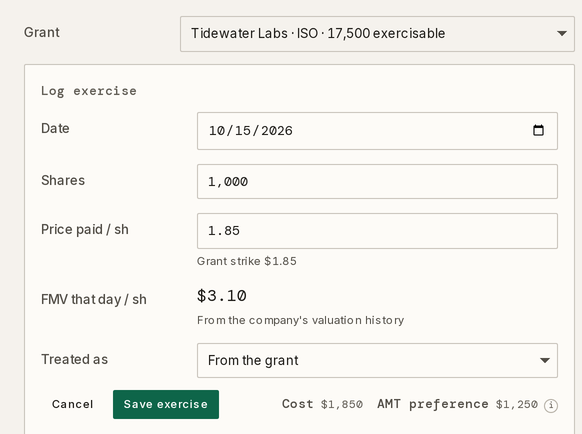
In Taiga Finance an exercise is logged against any vested option grant from its drawer: “Date”, “Shares”, “Price paid / sh” prefilled from the grant strike, “FMV that day / sh” prefilled from the company's 409A on that date, and “Treated as”, whose “NSO” option records a post-termination exercise on an ISO grant. The “Cost” shows before it saves.
Saved exercises sit in the grant's “Exercise history” with the date, shares, price paid, cost and the FMV then, and the drawer's “Exercised” count and amount paid update. A grant's owned shares count in Investments and net worth at the share of value the grant record is set to count; unexercised options stay out of net worth. Carta's exercises export imports as CSV, matched to grants at review.
Equity compensation →Key takeaways: Exercise
- Exercising an option means paying the strike to buy the shares it covers. Only vested options can be exercised, and only inside the exercise window.
- The cash cost is the strike times the shares.
- The FMV on the exercise date sets the spread, and on an NSO it is also the shares' cost basis. The holding period starts the day after the exercise.
- Exercised shares are owned shares; unexercised options are a right to buy.
Questions about Exercise
What does it mean to exercise stock options?
To buy the shares the options cover at the strike price. The holder pays the strike times the shares, and the company issues the shares. Before that, the options are a right to buy; after it, the shares are owned.
What does exercising options cost?
The strike times the shares exercised, in cash, on the exercise date. 1,000 options at a $2.00 strike cost $2,000. The tax on the spread comes on top: ordinary income for an NSO, an AMT adjustment for an ISO.
Can I exercise part of a grant?
Yes, any number of vested shares up to what is exercisable. A grant can hold several lots that way, one per exercise, with their own dates, FMVs and cost bases.
How does Taiga Finance track an option exercise?
An exercise is logged from the grant's drawer with its date, shares, price paid and the FMV that day, and its cost shows before it saves. It then appears in the grant's exercise history, and the exercised shares count in Investments and net worth at the share of value the grant record is set to count.