Home equity
Equity in a homeHome equity is the part of a home's value that belongs to the owner rather than to a lender: the property's current value minus every loan secured against it, the mortgage and any HELOC. It grows as the loans are paid down and as the value rises, and shrinks when either moves the other way.
What is home equity?
Two numbers make it. The debt side is exact: the mortgage balance and any HELOC balance, as the servicer reports them. The value side is an estimate until the day the home sells, whether it comes from an appraisal, a price index for the area or a neighbor's sale.
Equity is not cash. It cannot be spent without selling the home or borrowing against it, and a lender will only lend against part of it. That part is the HELOC capacity, which is smaller than the equity.
When the debt is larger than the value, the equity is negative and the home is underwater. The shortfall still counts against net worth.
How home equity works, with numbers
A home bought for $485,000 with a $388,000 mortgage starts with $97,000 of equity, the down payment. Six years later it is worth $650,000 and the mortgage is down to $340,000.
The equity is now $310,000. Of the $213,000 gain, $165,000 came from the rise in value and $48,000 from paying the loan down.
- Current value
- $650,000
- Mortgage balance
- − $340,000
- Home equity
- $310,000
Why home equity matters
It is a line in net worth that moves for reasons that have nothing to do with saving: a shift in the area's prices changes it without a dollar changing hands.
It is the base for borrowing: a HELOC's limit and a cash-out refinance both start from it. It also decides the proceeds of a sale, once the debt is repaid and the selling costs come out. Early in a mortgage it grows slowly, because most of each payment is interest rather than principal.
Home equity in Taiga Finance
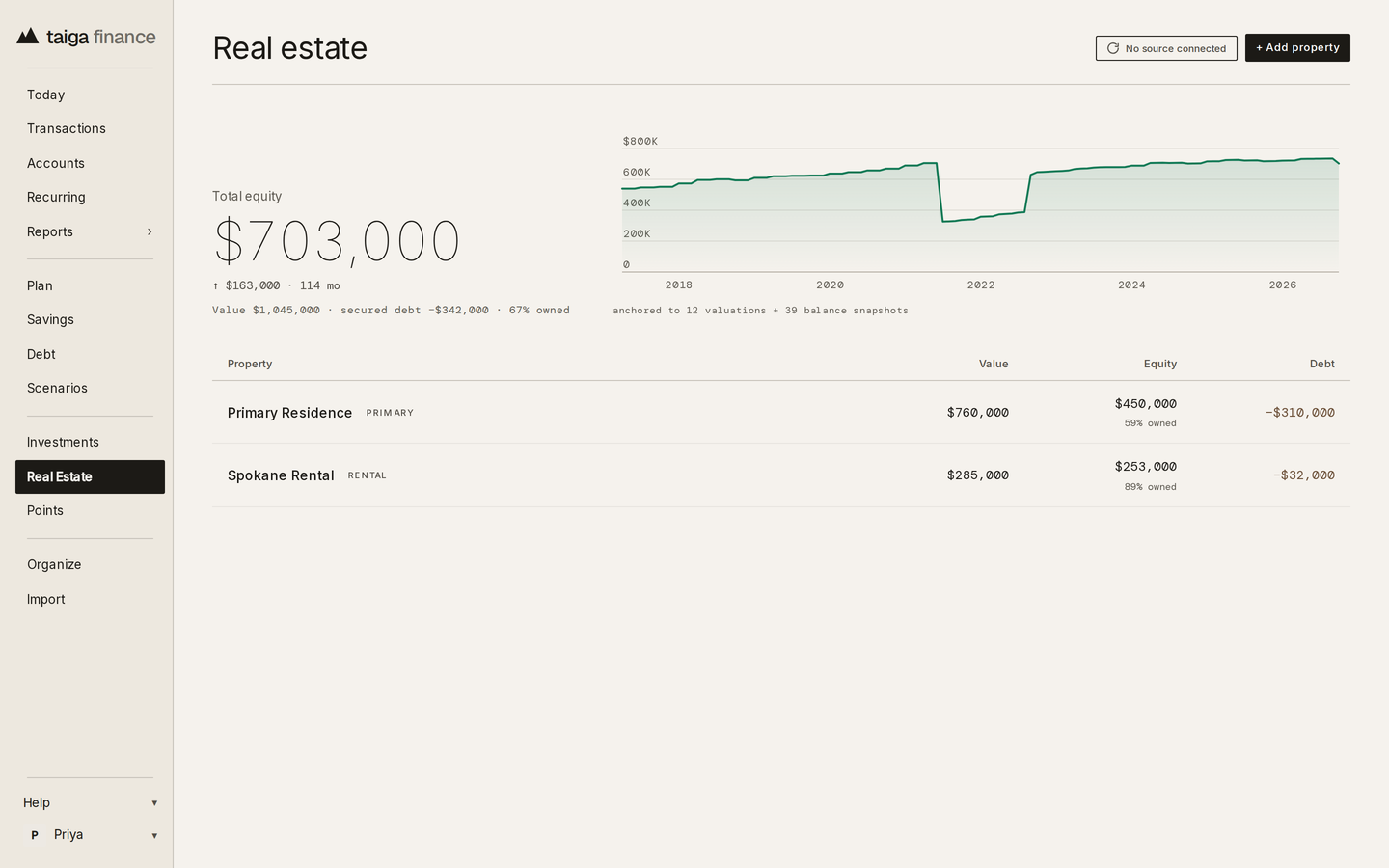
Taiga Finance shows each home on the Real estate page with three tiles: “Property value”, with its change since purchase under it, and “Mortgage balance” and “Equity”, each with its change over the past 12 months once the loan is a year old. An “Equity share” ring gives the equity as a percent of the home's value, and an “Equity over time” line draws it from the loan's first month to today. With more than one property, the list shows “Value”, “Equity” and “Debt” per home under a “Total equity” figure across them all.
The equity is rebuilt month by month from the property's valuation history and the mortgage's amortization schedule, with any HELOC linked to the home subtracted. The value is kept by hand or re-estimated each quarter from the FHFA House Price Index for the state or metro. A home worth less than its debt shows $0 of equity on its own page, while the shortfall stays visible in net worth.
Real estate, in the help center →Key takeaways: Home equity
- Home equity is the home's current value minus every loan secured against it.
- The debt side is exact; the value side is an estimate until the home sells.
- It is larger than HELOC capacity, which is only the part a lender will lend against.
- It changes with the value of the home as well as with each mortgage payment.
Questions about Home equity
What is home equity?
The part of a home's value the owner holds free of debt: the current value minus the mortgage balance and any HELOC balance. A $650,000 home with $340,000 owed on it has $310,000 of equity.
How is home equity calculated?
Subtract every loan secured by the home from its current value. The value is an estimate, from an appraisal or an area price index, so the equity is an estimate too. A negative result means the home is underwater.
Does Taiga Finance track home equity over time?
Yes. It keeps a dated valuation history for the home and walks the mortgage down its amortization schedule, then draws the equity as a line from the loan's first month to today, per property and across all of them.
Is home equity the same as HELOC capacity?
No. Equity is the whole gap between value and debt. HELOC capacity is the part of that gap under a lender's combined loan-to-value cap, so it is smaller.