Safe withdrawal rate
A safe withdrawal rate is the largest first-year withdrawal, as a percentage of a retirement portfolio, that did not exhaust the portfolio within a set number of years in a given record of market returns. The 4% figure comes from William Bengen's 1994 study built on US market returns from 1926.
What is a safe withdrawal rate?
In the method Bengen's study used, the rate sets the first year only. A 4% rate on a $1,000,000 portfolio is $40,000 in year one; from then on the dollar amount is adjusted for inflation, whatever the portfolio does. The rate is not taken again from the new balance each year.
“Safe” is defined against a record, not promised. In “Determining Withdrawal Rates Using Historical Data” (Journal of Financial Planning, October 1994), Bengen used the Ibbotson series for US common stocks, intermediate-term Treasury notes and inflation, starting a hypothetical retirement on January 1 of 1926, 1927 and each year through 1976. The portfolio was rebalanced continually, and the assets were assumed to sit in tax-deferred accounts.
Bengen reported that in the study, with a 50/50 portfolio, a 4% first-year withdrawal, adjusted for inflation each year after, had not exhausted a portfolio before 33 years in any period he tested. A 4.25% rate, he wrote, “could exhaust a portfolio in as little as 28 years, were past conditions to repeat themselves”, and he reported that a 3% rate lasted at least 50 years in every period of the study. Assuming a minimum requirement of 30 years, he wrote that a 4% first-year withdrawal followed by inflation-adjusted withdrawals “should be safe”.
How a safe withdrawal rate works, with numbers
A portfolio holds $1,000,000 on the first day of retirement. At a 4% first-year rate, the first year's withdrawal is $40,000. Inflation runs 3% that year, so the second year's withdrawal is $41,200.
If the portfolio has fallen to $800,000 by the start of year two, $41,200 is 5.15% of it. The dollar amount follows inflation; the share of the portfolio it takes moves with the market.
Read the other way, a $40,000 first-year withdrawal at 4% corresponds to a portfolio of $40,000 ÷ 0.04, which is 25 times the withdrawal: $1,000,000.
- Portfolio at retirement
- $1,000,000
- First-year rate
- × 4%
- First-year withdrawal
- $40,000
- Inflation in year one
- × 1.03
- Second-year withdrawal
- $41,200
Why a safe withdrawal rate matters
The rate turns a portfolio into a spending figure, or a spending figure into a portfolio: dividing by 4% is multiplying by 25.
The study's 4% result belongs to the study's inputs: returns data from Ibbotson's 1992 yearbook starting in 1926, a 50/50 portfolio of stocks and Treasury notes, a 30-year minimum, withdrawals adjusted for inflation, and assets held in tax-deferred accounts. A different horizon, mix or record of returns can give a different rate.
Safe withdrawal rate in Taiga Finance
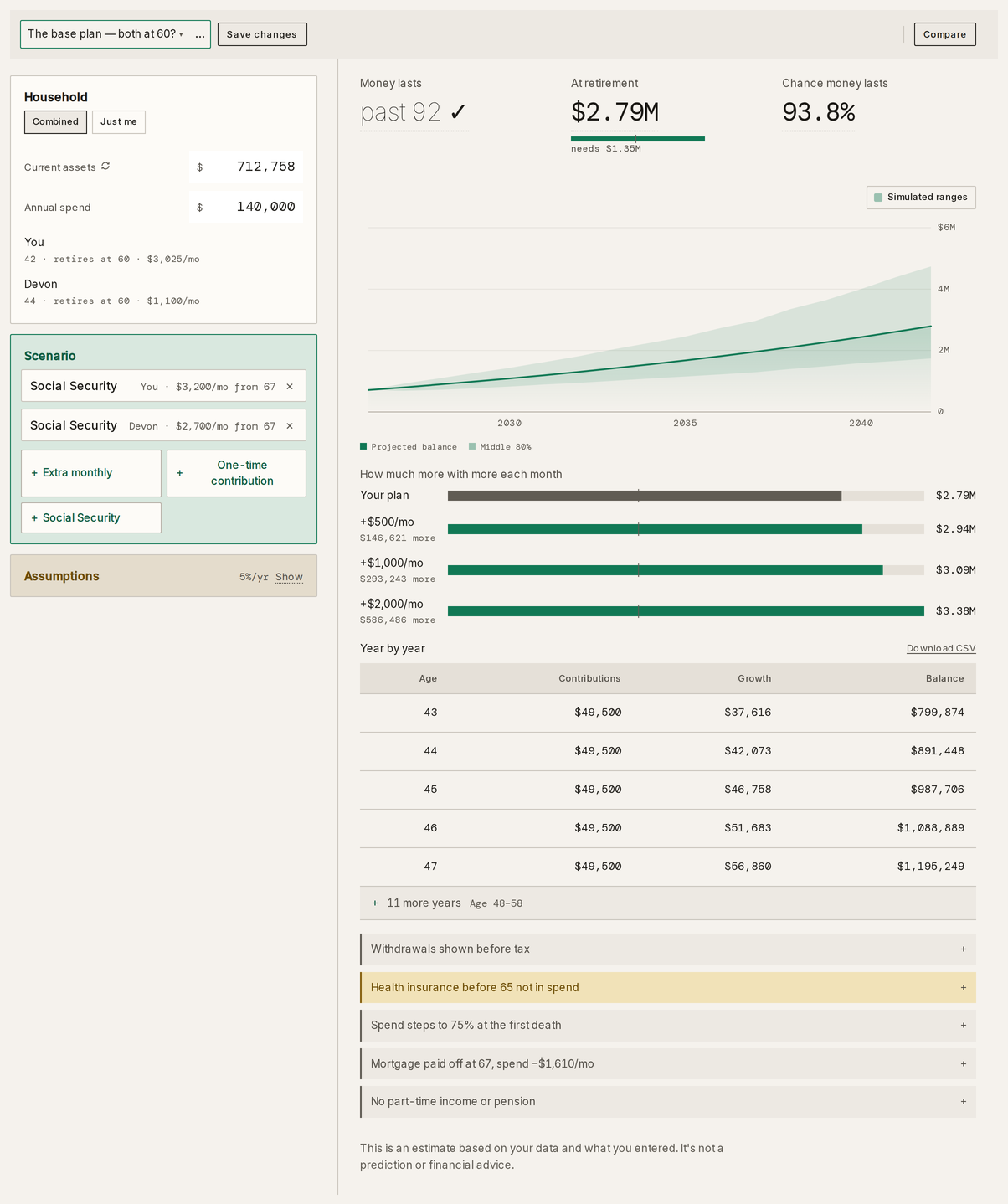
The Taiga Finance Retirement savings planner shows the rate inside its “Money lasts” figure. Opened, the working lists the annual spending, the balance at the retirement age and, as the “First-year withdrawal rate”, the plan's annual spending before Social Security divided by the projected balance at the first retirement age. Its caveat says the 4% rule is a reference, not a target.
The planner's “At retirement” figure reads the projected balance at the retirement age against the balance the plan needs there: the smallest balance from which the plan's own spending, Social Security included, lasts to the plan's end.
Scenarios & Reports →Key takeaways: Safe withdrawal rate
- In Bengen's method, the rate sets the first year's withdrawal as a percentage of the portfolio at the start of retirement.
- Bengen reported that in the study, a 4% first-year withdrawal adjusted for inflation did not exhaust a 50/50 portfolio before 33 years in any period he tested.
- “Safe” describes a result in one record of returns, for a stated horizon and portfolio mix.
- Dividing annual spending by 4% gives 25 times that spending.
Questions about Safe withdrawal rate
What is a safe withdrawal rate?
The largest first-year withdrawal, as a share of a retirement portfolio, that did not exhaust the portfolio within a set number of years in a given record of returns. In the method Bengen tested, the dollar amount is adjusted for inflation after the first year.
What is the 4% rule?
The finding of William Bengen's 1994 study, built on US market returns from 1926. Bengen reported that in the study a 4% first-year withdrawal from a 50/50 stock and Treasury note portfolio, adjusted for inflation each year, did not run out before 33 years in any period he tested.
How is a withdrawal amount worked out from a rate?
The rate times the portfolio on the first day of retirement gives the first year's dollars: 4% of $1,000,000 is $40,000. Under the method Bengen tested, later years take that amount adjusted for inflation, $41,200 after a 3% year, not the rate times the new balance.
What withdrawal rate does Taiga Finance show?
The Retirement savings planner's First-year withdrawal rate, a row in the working behind Money lasts, is the plan's annual spending, before Social Security, divided by the projected balance at the first retirement age. The working's caveat says the 4% rule is a reference, not a target.