Amortization
Amortization scheduleAmortization is the paying down of a loan through level payments, each split between the interest owed on the balance that month and a reduction of the principal, until the balance reaches zero. The table that lists the split for every month is the amortization schedule.
What is amortization?
The payment stays the same, but its make-up changes. Interest is charged on the balance still owed, so early on, when the balance is large, most of the payment is interest and only a little goes to principal. As the balance falls the interest share shrinks and the principal share grows, and the balance drops faster toward the end.
The level payment comes from the standard formula: the balance, the monthly rate and the number of payments fix it. A longer term means a lower payment and more interest over the life of the loan. A dollar of extra principal skips the interest it would have carried for the rest of the term, which is why paying extra early shortens a schedule by more than paying the same amount late.
How amortization works, with numbers
A $300,000 mortgage at 6% over 30 years has a payment of $1,798.65. In the first month the interest is $1,500, half a percent of the balance, and $298.65 goes to principal.
Principal only overtakes interest at the 223rd payment, 18 years and 7 months in. Over the full 360 payments the interest comes to about $347,500.
- Balance
- $300,000
- Monthly rate (6% ÷ 12)
- 0.5%
- Interest, month 1
- $1,500.00
- Payment
- $1,798.65
- To principal, month 1
- $298.65
Why amortization matters
The schedule decides how fast equity builds: in the early years each payment adds little to it, because so little goes to principal. It decides what a loan costs in total, and how much a rate change or an extra payment changes that total.
A refinance starts a new schedule at a new rate and term, and a recast restarts the payment on the old term. Both are read off the same arithmetic.
Amortization in Taiga Finance
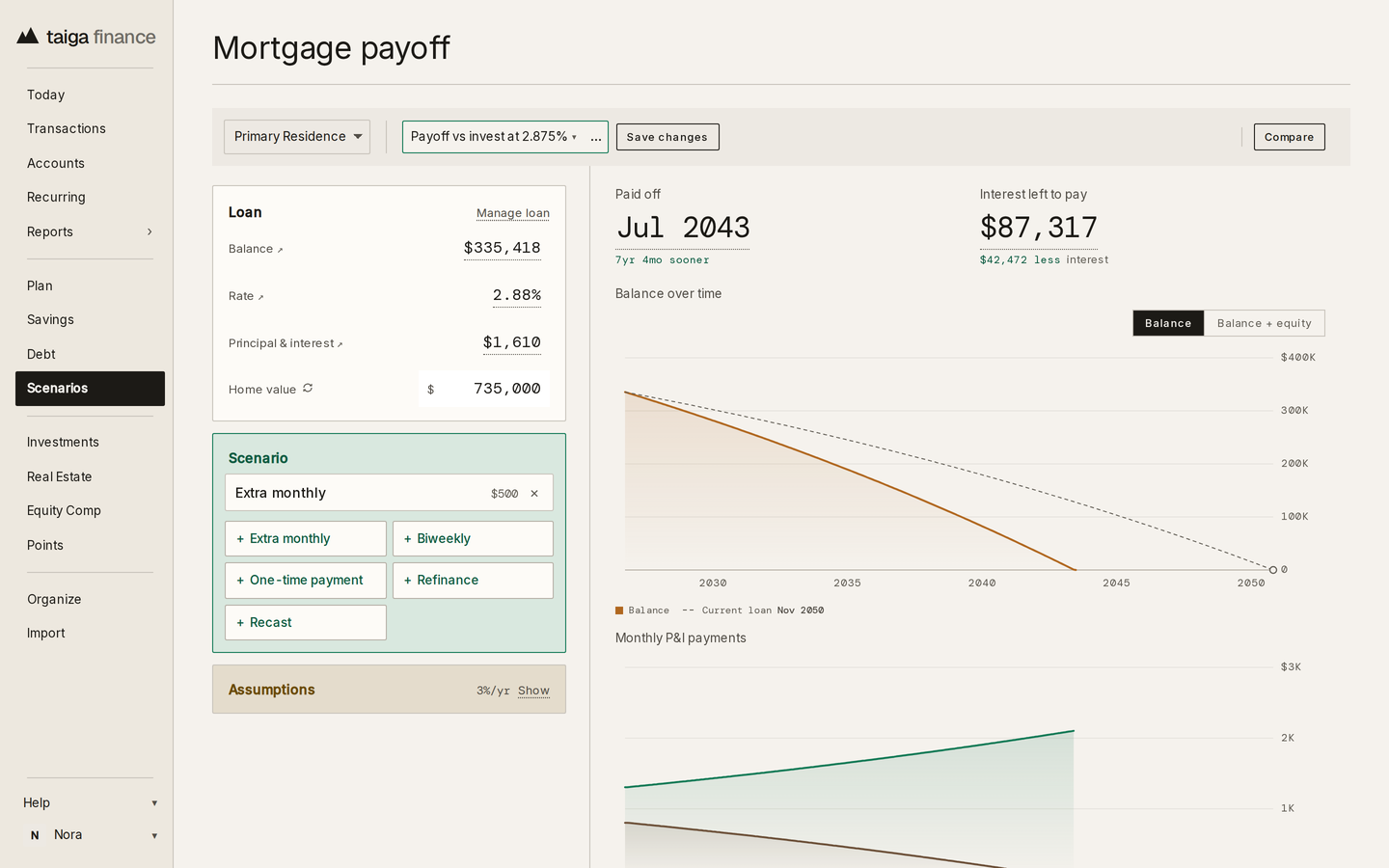
Taiga Finance shows a mortgage's schedule on the property's page. “This month's payment” is drawn as a bar split into “Principal” and “Interest”, each with its dollar figure and its share. The “Mortgage payoff” planner under it charts “Monthly P&I payments” as the principal and interest parts out to the payoff date, beside the headline readouts “Paid off” and “Interest left to pay”. The planner's “Month by month” ledger lists the schedule, with a “Download CSV”.
The schedule is built from the terms entered on the loan: the original principal, the rate and the term. Taiga Finance works out the scheduled monthly principal and interest from those three. A mortgage with no synced account walks its balance down the schedule month by month; a linked one takes the servicer's balance, and an imported statement pins each past payment's principal and interest to its date.
The public mortgage payoff calculator →Key takeaways: Amortization
- Amortization splits a level payment into interest on the balance and a reduction of the principal, month by month, until the balance is zero.
- Early payments are mostly interest; the principal share grows as the balance falls.
- The balance, the rate and the term set the payment. Extra principal shortens the schedule and cuts the total interest.
Questions about Amortization
What is loan amortization?
Paying a loan down through equal payments that each cover the month's interest and reduce the principal. The schedule that lists the split for every payment is the amortization schedule. A $300,000 loan at 6% over 30 years amortizes at $1,798.65 a month.
How does a mortgage amortization schedule work?
The month's interest is the balance times the monthly rate, the rest of the payment goes to principal, and the next month's interest is charged on the smaller balance. The interest share falls and the principal share rises until the balance reaches zero at the end of the term.
How much of my payment is principal versus interest?
It depends on the balance, the rate and how far into the term the loan is. On the first payment of a 30-year 6% loan, interest takes about five-sixths. Taiga Finance shows the current month's split on the property page and charts it out to payoff.
Does Taiga Finance show the full amortization schedule?
Yes. The mortgage payoff planner charts principal against interest month by month, lists the schedule month by month and exports it as a CSV. The public calculator shows the same schedule without an account.