Asset allocation
Allocation · Asset mixAsset allocation is how a portfolio's value is split across asset classes, such as stocks, bonds and cash, stated as a percentage of the whole for each class. The percentages add up to 100, and they change whenever one class's value moves differently from the others.
What is an asset allocation?
An asset class is a group of investments that behave alike: US stocks, international stocks, bonds, cash, real estate, and so on. The allocation is each class's value divided by the portfolio's total value. A portfolio of $240,000 in US stocks and $160,000 in bonds is 60% US stocks and 40% bonds.
A fund can span more than one class. A target-date fund that holds 90% stocks and 10% bonds contributes nine tenths of its value to stocks and one tenth to bonds when the allocation is worked out, so the mix describes what the holdings contain.
The allocation describes the portfolio as it stands. A target allocation is a stated mix the portfolio is meant to hold; the difference between the two is drift, and a trade made to close the difference is a rebalance.
How an asset allocation works, with numbers
A portfolio is worth $400,000. It holds $240,000 in US stock funds, $80,000 in an international stock fund, $60,000 in a bond fund and $20,000 in a money-market fund. Dividing each class by $400,000 gives 60% US stocks, 20% international stocks, 15% bonds and 5% cash, which add up to 100%.
Over the following year the US stock funds rise to $276,000 and the other three classes end where they started. The portfolio is now $436,000, and the same holdings read 63.3% US stocks, 18.3% international stocks, 13.8% bonds and 4.6% cash. No trade was made; the percentages moved because one class did.
- Portfolio value
- $400,000
- US stocks, $240,000 ÷ $400,000
- 60%
- International stocks, $80,000 ÷ $400,000
- 20%
- Bonds, $60,000 ÷ $400,000
- 15%
- Cash, $20,000 ÷ $400,000
- 5%
- Mix, US / Intl / Bonds / Cash
- 60 / 20 / 15 / 5
Why an asset allocation matters
The allocation is the one figure that describes a portfolio without listing its holdings. Twenty tickers across six accounts reduce to four percentages, and two portfolios with different funds can have the same mix.
Because each percentage is a share of the whole, the mix changes without a trade. In the example, a rise in one class took US stocks from 60% to 63.3% and lowered every other class's share, though their dollar values were unchanged.
Asset allocation in Taiga Finance
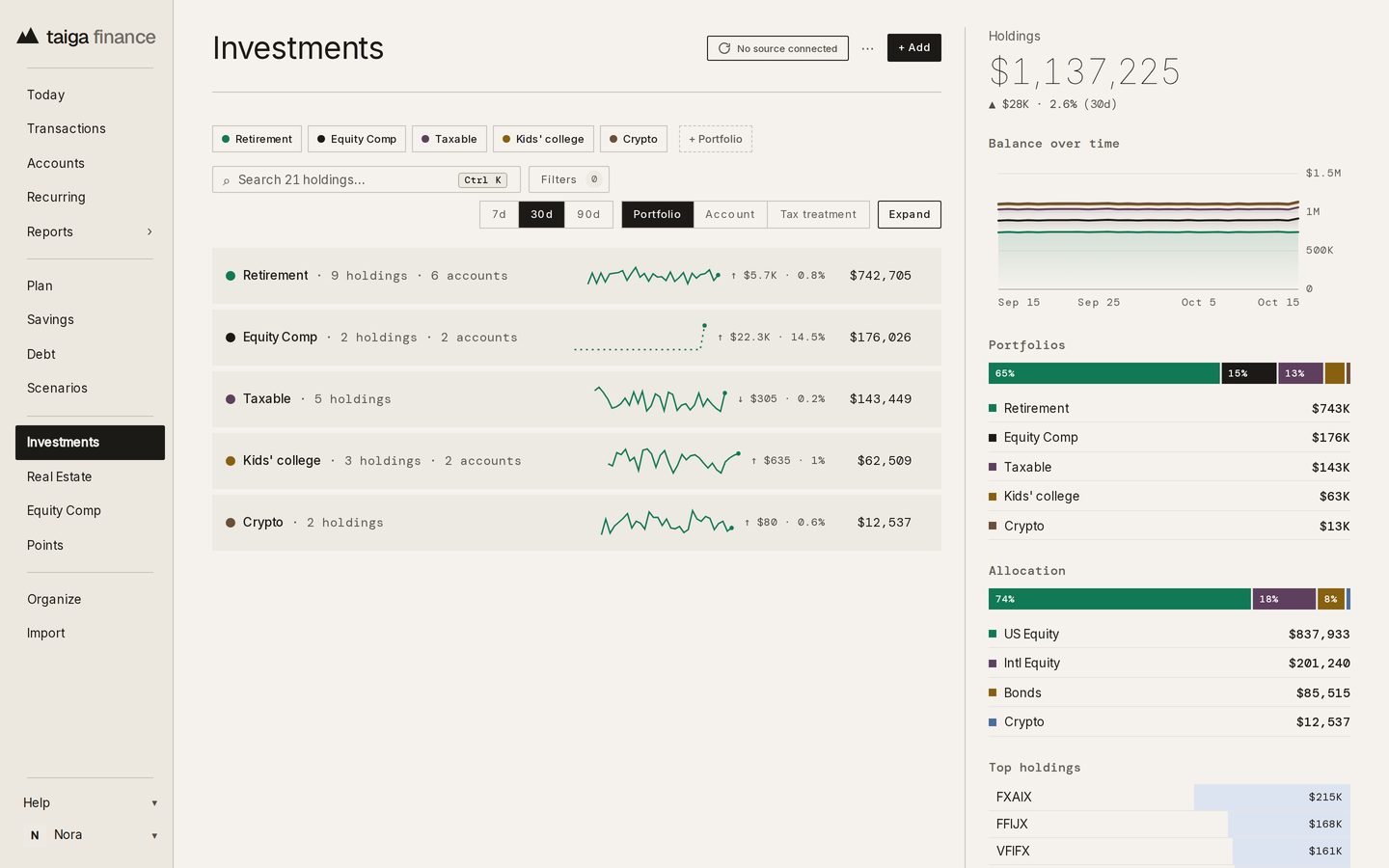
In Taiga Finance the rail on the Investments page shows an “Allocation” bar split by asset class, with each class that holds value listed beneath it with its dollar amount. The classes are “US Equity”, “Intl Equity”, “Bonds”, “Cash”, “Real Estate”, “Alternatives” and “Crypto”. A holding's class comes from a curated symbol list; a fund that spans several classes, such as a target-date fund, is prorated across them by its published composition, and a holding's drawer shows how it was classified and takes a custom mix. Clicking a class narrows the ledger to the holdings that count toward it.
A holding the app cannot classify sits outside the bar: the percentages are shares of the classified value, and the amount left out reads beneath the bar as “$X unclassified”. Clicking that line narrows the ledger to those rows.
A portfolio can hold a target mix. A dialog titled “Set a target” with the portfolio's name lists one percentage field per asset class under “Asset class targets”, and “Match current allocation” fills each field from the portfolio as it stands. With a target set, the portfolio's strip lists each class as its current share, an arrow and its target share under “Current → Target”.
Accounts & balances →Key takeaways: Asset allocation
- Asset allocation is each asset class's value divided by the portfolio's total, stated as percentages that add up to 100.
- A fund that holds more than one class is split across them by its composition, so the mix describes what the holdings contain.
- The percentages move when one class's value moves differently from the others, with no trade made.
- Taiga Finance shows the mix as the “Allocation” bar on the Investments page, across seven classes, and keeps unclassified value outside the percentages.
Questions about Asset allocation
What is asset allocation?
The split of a portfolio's value across asset classes, each stated as a percentage of the whole. $240,000 in US stocks, $80,000 in international stocks, $60,000 in bonds and $20,000 in cash out of $400,000 is a 60 / 20 / 15 / 5 mix.
How is asset allocation calculated?
The value in each asset class is divided by the portfolio's total value. A fund that holds several classes is split across them by its composition first. The percentages add up to 100.
Does Taiga Finance show my asset allocation?
Yes. The Investments page's rail has an Allocation bar by asset class, with each class's dollar value listed beneath it, across US Equity, Intl Equity, Bonds, Cash, Real Estate, Alternatives and Crypto. Value the app cannot classify is reported beneath the bar as unclassified rather than counted in the percentages.