Asset class
Asset categoryAn asset class is a group of investments that behave alike in the market and are counted alike in a portfolio, such as stocks, bonds and cash. A holding belongs to one class, or to several by weight when it is a fund that holds more than one, and the classes are the buckets an allocation is measured in.
What is an asset class?
The usual classes are stocks, often split into domestic and international, bonds, cash and its equivalents such as money-market funds, real estate, alternatives, and crypto. What separates them is how their prices tend to move: two US stock index funds rise and fall together more closely than a stock fund and a bond fund do.
A single-asset fund takes the class of what it holds: an S&P 500 index fund is US equity in whichever account it sits. A multi-asset fund, such as a target-date or balanced fund, holds several classes at once, so it is split across them by the weights in its filing rather than counted as one class.
Asset class is not account type. A Roth IRA and a taxable brokerage account can hold the same bond fund; the account type sets the tax treatment, and the class sets what the money is exposed to. The asset allocation entry covers the percentages built from the class totals.
How an asset class works, with numbers
A household holds five funds across two accounts: an S&P 500 index fund, $60,000; an international stock index fund, $20,000; a total bond market fund, $15,000; a money-market fund, $5,000; and a 2045 target-date fund, $20,000. The first four are one class each: US Equity, Intl Equity, Bonds and Cash.
The target-date fund's filing puts it at 54% US stocks, 36% international stocks and 10% bonds, so its $20,000 is split: $10,800 to US Equity, $7,200 to Intl Equity and $2,000 to Bonds. Added to the single-class holdings, the class totals are US Equity $70,800, Intl Equity $27,200, Bonds $17,000 and Cash $5,000. Five holdings become four figures, and the four sum to the $120,000 held.
- Target-date fund, $20,000 × 54% / 36% / 10%
- $10,800 / $7,200 / $2,000
- US Equity, $60,000 + $10,800
- $70,800
- Intl Equity, $20,000 + $7,200
- $27,200
- Bonds, $15,000 + $2,000
- $17,000
- Cash, money-market fund
- $5,000
- Four classes, five holdings
- $120,000
Why an asset class matters
The class is the unit an allocation is stated in. The percentages of a mix, a portfolio's target and its drift are all figured from class totals, so a holding with no class is left out of every percentage.
Sorting by class rather than by ticker or account collapses a ledger into a few figures. The example's five holdings in two accounts are four class totals, and the same fund held in two accounts lands in one class either way.
Asset class in Taiga Finance
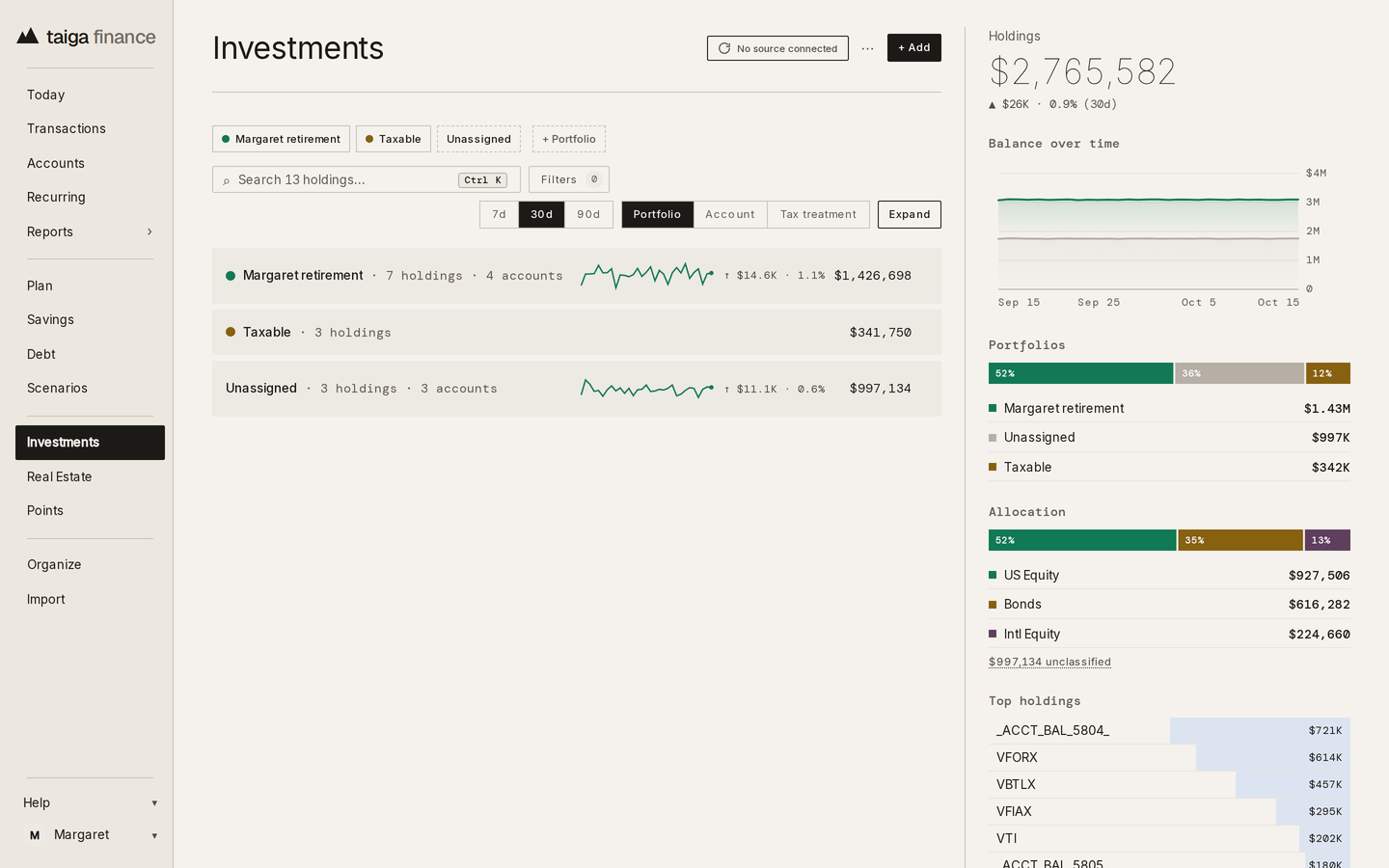
Taiga Finance sorts holdings into seven classes: “US Equity”, “Intl Equity”, “Bonds”, “Cash”, “Real Estate”, “Alternatives” and “Crypto”. A holding's drawer in Investments carries its class as a chip in the header, or “Unclassified” when none was found; a split fund with no dominant class carries no chip, and its “Fundamentals” section draws the split instead. The rail's “Allocation” section lists the class totals across the visible holdings, largest first, with a “$X unclassified” line beneath for the money in no class; clicking it narrows the ledger to those holdings.
The class comes from the holding itself. A symbol Taiga Finance recognizes takes its class from a curated list; a multi-asset fund in that list is split across its classes by the weights in its filing. A symbol it does not recognize takes the class of the holding's type when that is a bond, cash or crypto position, and is otherwise unclassified and counted in no allocation bucket.
The drawer's “Asset class” section is where it changes. It reads “Classified automatically.” or, for a split fund, “Split across N classes automatically.” Its “Custom mix” button opens an “Asset class mix” editor with one row per class, whose weights must equal 100%. One row counts the whole holding as that class; several rows split it by weight in place of the filing's. A saved mix reads “You set this mix. Clear it to fall back to automatic classification.”, with “Edit mix” and “Clear mix” beside it.
Accounts & balances →Key takeaways: Asset class
- An asset class is a group of investments that behave alike: stocks, bonds, cash, real estate, alternatives, crypto.
- A single-asset fund is one class; a multi-asset fund is split across classes by the weights in its filing.
- Class is not account type. The same bond fund is Bonds in an IRA and in a taxable account.
- Taiga Finance sorts holdings into seven classes automatically, and a holding's drawer takes a custom mix that replaces the automatic one.
Questions about Asset class
What is an asset class?
A group of investments that behave alike in the market and are counted alike in a portfolio. Stocks, bonds and cash are the common ones; real estate, alternatives and crypto are often kept separate. A fund that holds several is split across them by weight.
What asset classes does Taiga Finance use?
Seven: US Equity, Intl Equity, Bonds, Cash, Real Estate, Alternatives and Crypto. A holding it cannot place reads Unclassified and is counted in no bucket; the Allocation section lists that money beneath the classes as unclassified.
How do I change a holding's asset class in Taiga Finance?
In the holding's drawer, opened from the Investments ledger, under Asset class. Custom mix opens an editor with a row per class, weights summing to 100%; one row counts the whole holding as that class. Clear mix returns it to automatic classification.