ISO
Incentive stock optionAn ISO is an incentive stock option, a US employee stock option that meets the conditions of Section 422 of the tax code. Exercising one creates no regular taxable income; the spread counts toward the alternative minimum tax instead, and a sale after the required holding periods is taxed as a capital gain.
What is an ISO?
A stock option is the right to buy a set number of shares at a fixed strike price. An ISO is the kind granted only to employees, with a term of at most ten years, a strike no lower than the fair market value on the grant date, and a $100,000 cap on the grant-date value of the shares under ISOs that first become exercisable in any one calendar year. Options that miss any of those conditions are NSOs.
The tax treatment is what sets the two apart. On an NSO, the spread between the strike and the market value is ordinary income the day the option is exercised. On an ISO, nothing happens at exercise for regular income tax. The same spread is added back for the alternative minimum tax, so an ISO exercise can still produce a tax bill in the exercise year.
The capital-gain treatment holds only if the shares are kept for more than two years from the grant date and more than one year from the exercise date. A sale inside either window is a disqualifying disposition, and the spread becomes ordinary income in the year of the sale, capped at the gain on the sale when it is a sale on which a loss, if sustained, would be recognized.
How an ISO works, with numbers
An employee holds 1,000 ISOs with a $2.00 strike, granted three years ago. The company's 409A is $5.00, so exercising all of them costs $2,000 and the spread is $3,000. For regular tax that year, the spread is not income; it is a $3,000 adjustment in the AMT calculation.
More than a year later the shares sell at $9.00. Both holding periods are met, so for the regular tax the whole gain over the strike is a long-term capital gain.
- Sale price, per share
- $9.00
- Strike, per share
- − $2.00
- Gain per share
- $7.00
- Shares
- × 1,000
- Long-term capital gain, regular tax
- $7,000
Why an ISO matters
The type on the grant decides when the spread is taxed and as what. An ISO defers the ordinary-income question to the sale, and only if the shares are sold early. In exchange the spread lands in the AMT calculation in the exercise year, whether or not the shares can be sold.
ISO status also depends on staying employed. The tax code requires the holder to be an employee until three months before the exercise date; an exercise later than that is taxed as an NSO.
ISO in Taiga Finance
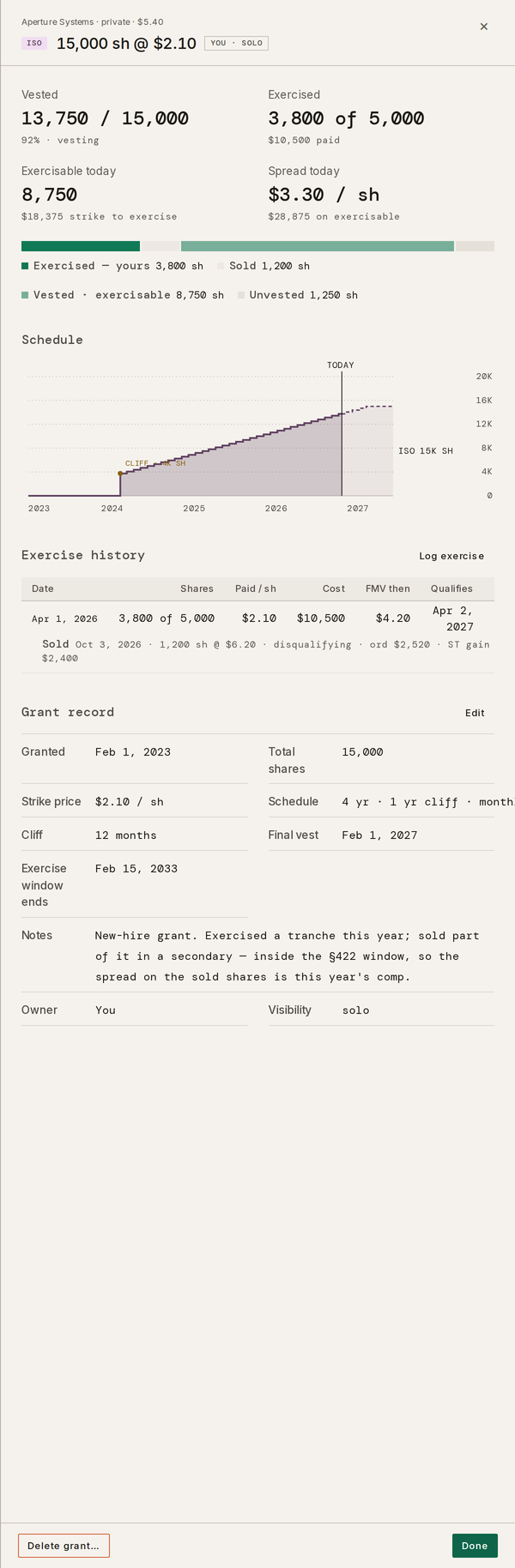
Taiga Finance labels each option grant ISO or NSO on its row. An ISO grant's drawer shows what it holds: “Vested”, “Exercised” with the amount paid, “Exercisable today” with the strike to exercise it, and “Spread today” per share and on the exercisable shares, at the company's latest 409A.
A logged exercise records the price paid and the FMV that day, and its “Treated as” field, with “From the grant”, “ISO” and “NSO”, records a post-termination exercise as an NSO. A recorded sale is split into ordinary income and gain by whether it qualifies. The year's figures note which spread still carries AMT preference.
Equity compensation →Key takeaways: ISO
- An ISO is an employee stock option that meets Section 422: employees only, a ten-year term, a strike at or above the grant-date value, and $100,000 of grant-date share value first exercisable a year.
- Exercising an ISO creates no regular income. The spread counts in the AMT calculation for that year.
- A sale more than two years from grant and more than one year from exercise is a long-term capital gain on the whole gain over the strike.
- An earlier sale is a disqualifying disposition, and the spread is ordinary income in the year of the sale.
Questions about ISO
What is an ISO?
An incentive stock option: an employee stock option that meets the conditions in Section 422 of the US tax code, with a tax treatment that keeps the spread out of regular income at exercise.
What is the difference between an ISO and an NSO?
Timing and character of the tax on the spread. An NSO's spread is ordinary income at exercise. An ISO's spread is an AMT adjustment at exercise, and a sale after the holding periods is a capital gain. NSOs can also go to non-employees; ISOs can't.
How are ISOs taxed?
Nothing at grant. At exercise, nothing for regular tax, and the spread is an AMT adjustment. At sale, a long-term capital gain on the gain over the strike if the shares were held more than two years from grant and one from exercise; otherwise the spread is ordinary income in the year of the sale.
Does Taiga Finance show the AMT on an ISO exercise?
It shows the spread at the current FMV, per share and in total, and the year's figures note which spread still carries AMT preference.