Qualifying disposition
A qualifying disposition is a sale of ESPP or ISO shares made more than two years after the option was granted and more than one year after the shares were bought or exercised. Meeting both holds is what lets most or all of the gain be taxed as long-term capital gain instead of ordinary income.
What is a qualifying disposition?
The rule comes from Sections 421 to 423 of the US tax code. For an ISO the grant date is the date on the grant. For an ESPP it is the first day of the offering when the plan sets a maximum number of shares each employee may buy in that offering; when it does not, the purchase date is the grant date. The one-year leg runs from the ESPP purchase or the ISO exercise, and a sale on either anniversary is still inside the hold.
Qualifying is not the same as long-term. Shares held more than a year from the purchase are long-term for capital gains, but if two years have not passed from the grant the sale is still disqualifying. Both clocks have to be past.
The split differs by plan. On a qualifying ESPP sale the ordinary income is the lesser of the plan's discount measured at the grant-date price and the actual gain; the rest is long-term capital gain, and a sale at a loss carries no ordinary income. On a qualifying ISO sale there is no ordinary income: the whole gain over the strike is long-term capital gain.
How a qualifying disposition works, with numbers
An ESPP offering starts March 1, 2024 with the stock at $20, under a plan that caps the shares each employee may buy in the offering, so that day is the grant date. On November 1, 2024, with the stock at $25, 200 shares are bought at $17 under a 15% discount with a lookback. Sold on September 15, 2026 at $30, the sale is past both holds: two years from the offering start ran to March 1, 2026 and one year from the purchase to November 1, 2025, so the lot has qualified since March 2, 2026.
The gain is $13 a share, $2,600 on the lot. Ordinary income is capped at 15% of the $20 grant-date price, $3 a share, so $600 is ordinary income and the remaining $2,000 is long-term capital gain.
- Sale, 200 sh × $30
- $6,000
- Paid, 200 sh × $17
- − $3,400
- Gain
- $2,600
- Ordinary income, 15% × $20 × 200
- − $600
- Long-term capital gain
- $2,000
Why a qualifying disposition matters
The holds change the character of the income, not its size. The same $2,600 sold six months after the purchase would be $1,600 of ordinary income and $1,000 of short-term gain. The income lands in the year of the sale either way.
For an ISO the difference is larger: a qualifying sale has no ordinary income, so the spread measured at exercise, an AMT item that year, never becomes ordinary income. The employer's Form 3921 for an ISO exercise and Form 3922 for ESPP shares carry the dates and prices the split is worked from.
Qualifying disposition in Taiga Finance
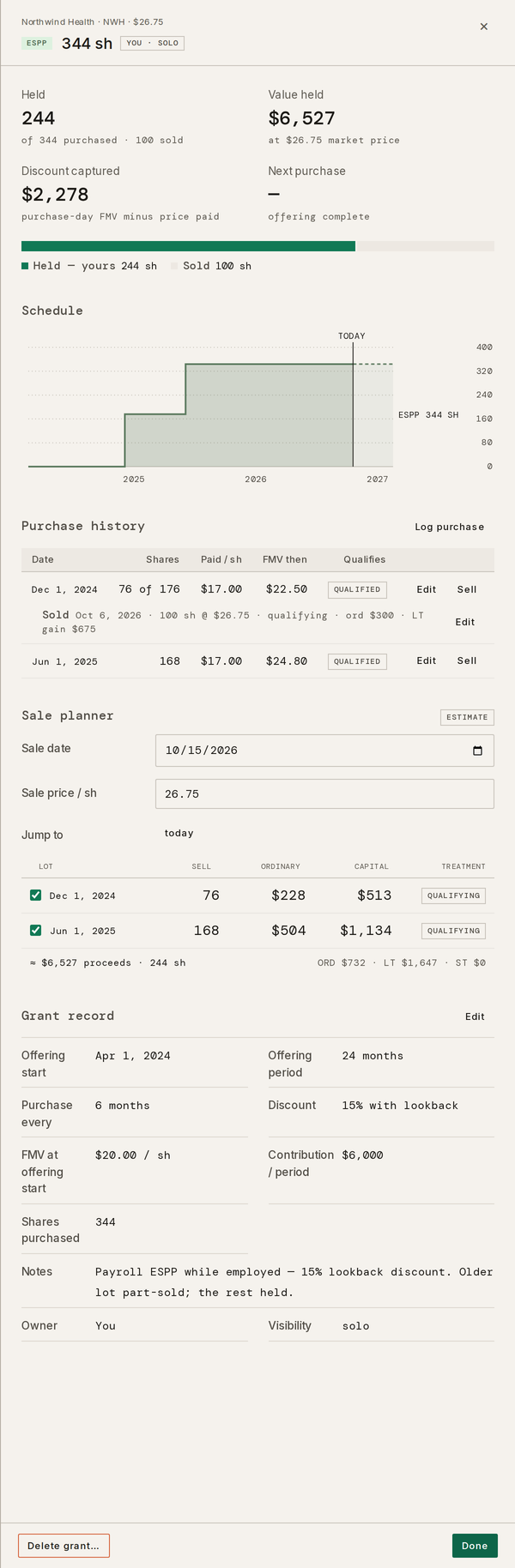
Taiga Finance shows each ESPP lot's qualifying date in a Qualifies column of the purchase history, and the tag QUALIFIED once the date is reached. The sale planner prices a sale on any date, lot by lot, with ORDINARY and CAPITAL columns and a TREATMENT column reading QUALIFYING or DISQ. UNTIL the date; the totals split the capital part into LT and ST, and the next qualifying dates sit under Jump to.
A lot that has not yet qualified shows in the Coming up list as “ESPP lot qualifies” with the shares held. A recorded sale of an ESPP lot or an ISO exercise lot keeps its treatment on its row: qualifying or disqualifying, the ordinary income and the LT or ST gain.
Equity compensation →Key takeaways: Qualifying disposition
- A qualifying disposition needs more than two years from the grant and more than one year from the purchase or exercise. Both clocks must be past.
- On an ESPP it caps the ordinary income at the discount measured at the grant-date price. On an ISO it removes the ordinary income entirely.
- Long-term and qualifying are different tests. A sale can be long-term and still disqualifying.
Questions about Qualifying disposition
What is a qualifying disposition?
A sale of ESPP or ISO shares more than two years past the grant date and more than one year past the purchase or exercise date. It caps the ordinary income on an ESPP sale at the discount and removes it on an ISO sale; the rest is long-term capital gain.
What are the ESPP qualifying disposition rules?
The shares are sold more than two years after the grant date and more than one year after the purchase. The ordinary income is then the lesser of the plan's discount at the grant-date price and the actual gain, and the rest is long-term capital gain.
How long do ESPP shares have to be held to qualify?
Until both dates have passed: two years from the grant date, which is the offering's first day when the plan caps the shares each employee may buy, and one year from the purchase. For a lot bought eight months into a 24-month offering under such a plan, the two-year date is the later one.
Does Taiga Finance show when an ESPP lot qualifies?
Yes. The purchase history lists the date per lot, the Coming up list carries the ones still ahead, and the sale planner marks a lot on a chosen sale date as qualifying or disqualifying.