Plan
BudgetA plan, the word Taiga Finance uses for a budget, sets amounts from a month's take-home pay for investments, savings and each kind of spending, ahead of the month. Through the month, what actually came in and went out is compared with it.
What is a plan?
A budget is set before the money moves. A spending tracker records where money went after the fact. The budget states an amount in advance, so spending can be read against it as over or under.
A plan is built from lines. A paycheck line says what that paycheck is expected to bring in. A spending line names a kind of spending, such as groceries or dining out, and the amount set for it. Investment and savings lines say how much goes to each account or goal. Take-home pay, the amount deposited after taxes and payroll deductions, minus everything assigned to the lines is what is left to allocate.
How a plan works, with numbers
A household's take-home is $6,000 a month. The plan puts $600 toward investments, $300 toward savings and $4,500 across the spending lines. That is 10%, 5% and 75% of take-home, and $600 is left to allocate.
On day 15 of a 30-day month, the spending lines have $2,100 spent against them. Half the month is $2,250 of the $4,500 planned, so spending is $150 under that pace.
- Take-home
- $6,000
- Investments
- − $600
- Savings
- − $300
- Spending
- − $4,500
- Left to allocate
- $600
Why a plan matters
The plan is the fixed side of the comparison. With $4,500 planned for spending, $2,100 spent by the middle of the month reads as $150 under pace; without an amount set in advance, $2,100 has nothing to be measured against.
Plan in Taiga Finance
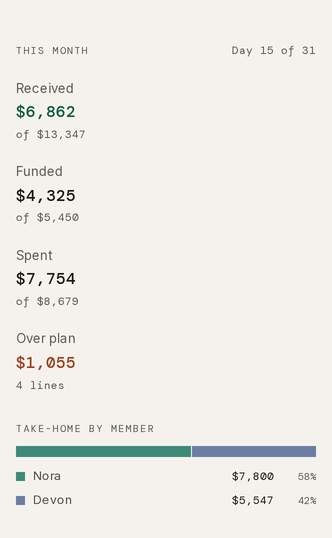
In Taiga Finance the budget is the Plan. Its sections are Income, Investments, Savings and Spending; when the plan has fixed lines, Spending splits into Fixed costs and Variable spending. A spending line claims categories, and spending in them counts against it. When the plan has a catch-all line, such as “Everything else”, it takes the spending no other line claims, apart from spending it can't route, which the rail lists as Unbudgeted.
A spending line with a planned amount shows what has been spent beside that amount, with a meter that marks how far through the month it is. The spent figure is marked once spending passes the planned amount. A spending line other than the catch-all is set to “Resets” or to “Carries over”, which carries its balance, unspent or overspent, into the next month as an available balance.
A band at the top of the Plan draws the planned amounts for Investments, Savings and Spending, or Fixed costs and Variable spending, as segments of the month's take-home; what they don't claim is the band's tail, “Left to allocate”, whose working reads take-home minus planned, and a plan with more planned than take-home reads “Over”. The rail beside the lines reads “This month”: Received against the take-home, Funded, Spent against planned spending, Over plan and Unbudgeted.
Plan & goals →Key takeaways: Plan
- A plan, or budget, sets amounts from a month's take-home pay for investments, savings and each kind of spending before the month happens.
- Take-home pay, the amount deposited after taxes and payroll deductions, minus everything assigned to the lines is what is left to allocate.
- In Taiga Finance, a spending line on the Plan either resets each month or carries its balance into the next.
- Taiga Finance calls its budget the Plan and shows a spending line's spending against its planned amount through the month.
Questions about Plan
Does Taiga Finance have a budget?
Yes, under the name Plan. It is a page of income, investment, savings and spending lines, and a spending line with a planned amount fills in from transactions through the month.
What is a Plan in Taiga Finance?
The budget. It lists the month's income, investment, savings and spending lines, beside a rail that opens on take-home pay and gives Investments, Savings and Spending each as a share of it when it has a planned amount, and shows the difference as what is left to allocate while they don't add up to that take-home.
What is the difference between a budget and a spending tracker?
A tracker records what was spent. A budget sets an amount for each line before the month, so spending can be read as over or under it.