RSU
Restricted stock unitAn RSU (restricted stock unit) is an employer's promise to hand over one share of its stock once a vesting condition is met, such as continued employment through a schedule. Nothing is bought: the shares arrive on the vest date, and their value that day is taxed as wages.
What is an RSU?
A unit is not a share. Until it vests, the holder owns nothing, pays nothing and can sell nothing. The grant's schedule says when units turn into shares.
The confusion is with stock options. An option carries a strike price, and if the stock falls below it the option is worth nothing. An RSU has no strike: a vested unit is worth whatever the share is worth that day, even after the price has fallen since the grant.
Because a vest is wages, the employer withholds tax on it, and the withholding can be taken in shares. When it is, the share count that lands in the brokerage account is smaller than the count that vested.
How an RSU works, with numbers
A grant of 1,600 RSUs vests 100 units a quarter. On a vest date the share price is $40, so that quarter's vest is $4,000 of wages.
With 22% withheld, $880, the employer keeps back 22 of the 100 units. 78 shares are delivered, with a cost basis of $40 each, $3,120 in all.
- Units vesting
- 100
- Share price at vest
- × $40
- Wages at vest
- $4,000
- Withheld at 22%
- − $880 (22 sh)
- Shares delivered
- 78 sh · $3,120
Why an RSU matters
The value of the shares on the vest date, less anything paid for them, is ordinary income in the year they vest (or the year they are delivered, if settlement comes later), owed whether or not the shares are sold.
The withholding at vest and the tax owed on it are two different numbers; the tax owed is set by the holder's bracket for the year.
After the vest, the shares are ordinary stock. The basis is the vest-day value, the holding period starts when the shares are delivered, and a later sale is a capital gain or loss on the difference, long-term after more than a year.
RSU in Taiga Finance
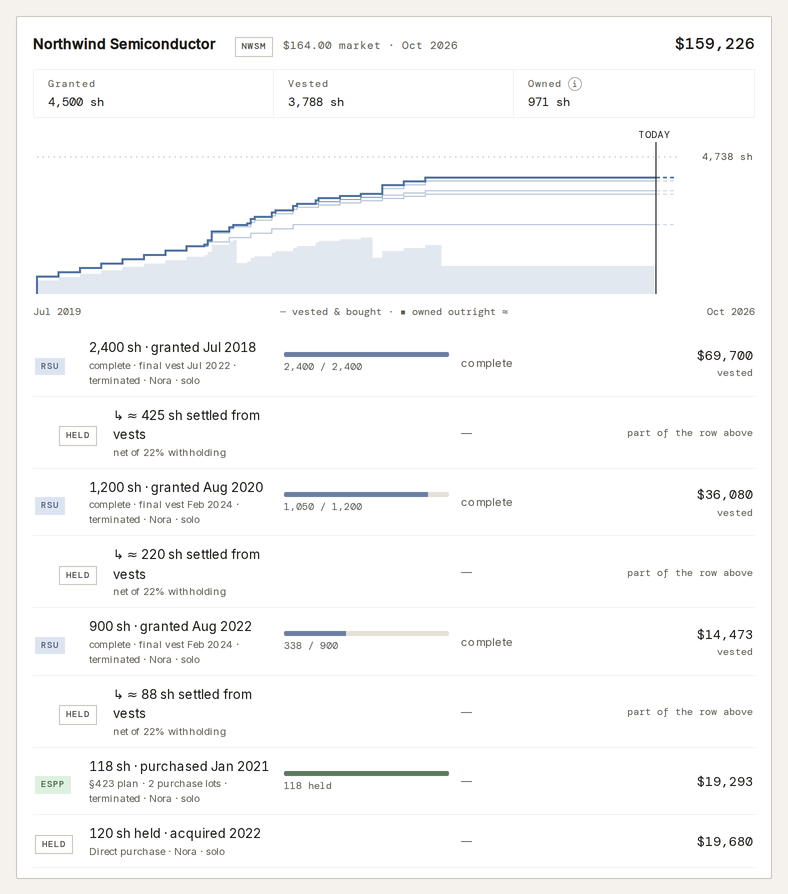
In Taiga Finance an RSU grant is a row under its company on the Equity Comp page: share count and grant month, the schedule as a progress bar with its count, the final vest date and the value vested. Under it a second row reads “↳ ≈ 425 sh settled from vests”, with the withholding rate recorded on the grant noted beneath, and the company header counts Granted, Vested and Owned shares separately.
A grant's owned shares count in Investments and net worth at the share of value the grant record is set to count. Value that has vested but is not yet held shows as “Vested, not owned” and stays out of net worth.
Equity compensation →Key takeaways: RSU
- An RSU is a promise of one share on a vest date. There is no strike and nothing to pay.
- The vest-day value is wages in the year of vest, whether or not the shares are sold.
- Withholding can be taken in shares, so fewer shares are delivered than vested.
- After the vest the shares are ordinary stock, with the vest-day value as their cost basis.
Questions about RSU
What is an RSU?
A restricted stock unit: an employer's promise to deliver one share once a vesting condition is met, such as continued employment through a schedule. The holder pays nothing and owns nothing until the vest date.
How are RSUs taxed?
The value of the shares on the day they vest is ordinary income for that year, taxed like salary, with withholding that can be taken in shares. From then on the shares have a cost basis equal to the vest-day value, and a later sale is a capital gain or loss against it.
What is the difference between an RSU and a stock option?
An option is the right to buy a share at a fixed strike, worth nothing if the stock is below it. An RSU delivers the share at no cost, so a vested unit is worth the share price whatever has happened since the grant. An option is taxed at exercise or sale; an RSU at vest.
Does Taiga Finance count RSUs in net worth?
Shares settled from vests count as owned, net of the withholding rate recorded on the grant. A grant set to “Include in portfolios” counts its owned shares in Investments and net worth, at its “Count at (FMV %)” setting; the default is excluded. Value that has vested but is not yet held shows as “Vested, not owned” and stays out of net worth.