Cash flow
Net cash flowCash flow is the money that came in over a period, usually a month, minus the money that went out; it is positive when more arrived than left and negative when more left than arrived. It measures movement over a stretch of time, where net worth measures what is owned and owed on one date.
What is cash flow?
Cash flow counts what moved. A paycheck deposited is money in; rent, groceries and a card purchase are money out. The difference over the period is the net cash flow, the figure the term usually means.
A transfer between two of a household's own accounts is neither. Moving $500 from checking to savings changes where the money sits, not how much there is, and paying a credit card bill settles purchases that already counted as money out when they were made.
Cash flow and net worth answer different questions. Net worth is a balance on one date: assets minus debts. Cash flow is a flow between two dates. The two can move in opposite directions in the same month, because net worth also moves with prices: a brokerage account or a home can lose value without a dollar leaving.
How cash flow works, with numbers
In one month a household takes in $6,000 and spends $4,800. Its cash flow for the month is a positive $1,200.
In the same month the market falls and the household's brokerage account is worth $3,500 less at the end of the month than at the start. Nothing was sold. Its net worth moved by the $1,200 of cash kept minus the $3,500 of value lost: a drop of $2,300, in a month of positive cash flow.
- Money in
- $6,000
- Money out
- − $4,800
- Net cash flow
- $1,200
- Market loss, brokerage
- − $3,500
- Change in net worth
- − $2,300
Why cash flow matters
Cash flow is the part of a month's change that earning and spending account for. The $1,200 kept in the example came from what was earned and what was spent; the $3,500 came from prices, which no spending line touches. Read apart, the two figures say which one moved.
Over time, kept cash flow is what funds savings and investments. A month with negative cash flow is paid for from somewhere: a balance drawn down, or a card balance carried.
Cash flow in Taiga Finance
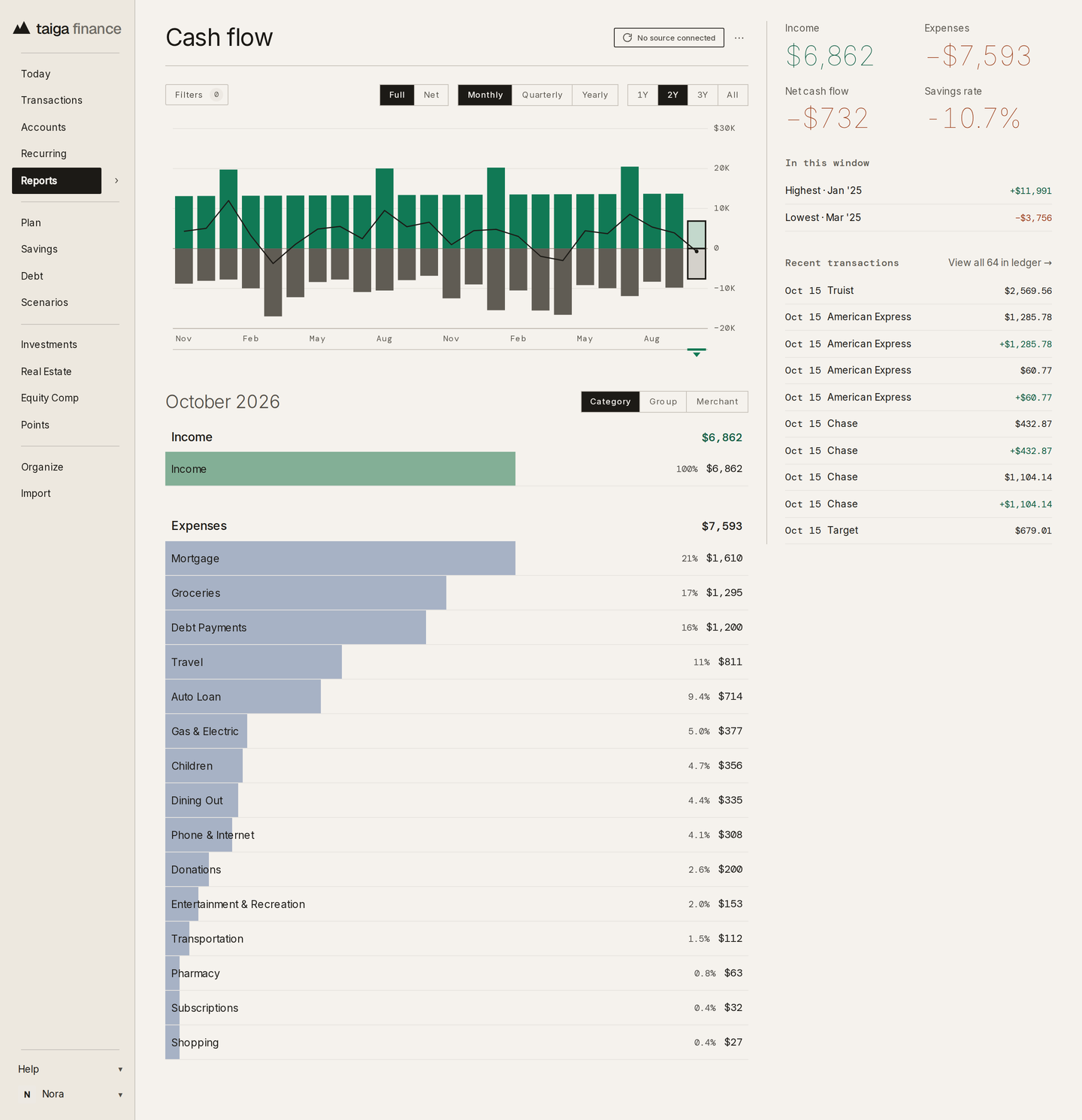
Taiga Finance's Cash flow report draws income against spending for every month, quarter or year of the transaction history, with a line for the net through the columns; the period in progress is drawn faded. For the selected period it gives four figures: “Income”, everything in the Income category; “Expenses”, every other settled transaction outside Transfers, with refunds subtracted; “Net cash flow”, income minus expenses; and “Savings rate”, the net as a share of income, which reads “—” in a period with no income. Hovering a figure compares it with the “Previous” period and with “Typical”, the average of the completed periods in the range.
Under the chart, the period's “Income” and “Expenses” bands list where the money came from and went, by “Category”, “Group” or “Merchant”, each row with its share and its amount. “In this window” names the “Highest” and “Lowest” net periods in the range. A transfer between the household's own accounts, a card payment included, counts on neither side.
The Cash Flow Sankey draws one period as a flow: one block per income category on the left, one per spending group on the right, and the difference as “Net saved”. When spending exceeds income, a “Savings drawdown” block appears on the left instead. Net worth is a separate figure, on the Accounts page as “Position”; the cash flow report reads transactions, not balances.
Scenarios & Reports →Key takeaways: Cash flow
- Cash flow is money in minus money out over a period; net cash flow is the difference.
- Net worth is a balance on one date. Cash flow is a flow between two dates, and the two can move in opposite directions in the same month.
- A transfer between a household's own accounts, a credit card payment included, is neither money in nor money out.
- In Taiga Finance, the Cash flow report gives each period an Income, an Expenses, a Net cash flow and a Savings rate figure, and the Sankey draws one period as a flow ending in Net saved.
Questions about Cash flow
What is cash flow?
The money that came in over a period minus the money that went out, usually a month. A household that takes in $6,000 and spends $4,800 has a cash flow of $1,200 for the month.
What is the difference between cash flow and net worth?
Cash flow is movement over a period: what came in minus what went out. Net worth is a balance on one date: what is owned minus what is owed. Net worth also moves with prices, so a month can have positive cash flow and a falling net worth when a market drop outweighs the cash kept.
Does Taiga Finance have a cash flow report?
Yes. The Cash flow report draws income against spending by month, quarter or year with a net line, and gives the selected period's Income, Expenses, Net cash flow and Savings rate. The Cash Flow Sankey draws one period as a flow from income to spending groups and Net saved.