Disqualifying disposition
A disqualifying disposition is a sale of ESPP or ISO shares before both holding periods have run: two years from the grant date and one year from the purchase or exercise date. It makes the discount or spread the shares carried on the day they were bought ordinary income in the year of the sale.
What is a disqualifying disposition?
Under Sections 421 to 423 of the US tax code, shares bought through a Section 423 ESPP or an ISO exercise are not taxed when they are bought. That deferral holds only if the sale is more than two years from the grant and more than one year from the purchase or exercise. A sale inside either window is disqualifying, and the deferred income lands in the year of the sale.
The word suggests a penalty; it is a change of character. For an ESPP lot the ordinary income is the purchase-day price minus the price paid, owed even if the shares are sold at a loss. The price paid plus that income is the new cost basis, and the sale price against it is a capital gain or loss, short- or long-term by the time held from the purchase.
For an ISO lot the ordinary income is the exercise-day price minus the strike, the bargain element. When the shares are sold below the exercise-day price, the ordinary income is capped at the gain on the sale when it is a sale on which a loss, if sustained, would be recognized. When they are sold above it, the rest of the gain is capital gain.
How a disqualifying disposition works, with numbers
An ESPP offering starts with the stock at $20, under a plan that caps the shares each employee may buy in the offering, so that day is the grant date. On November 1, 2024, with the stock at $25, a lot of 200 shares is bought at $17 under a 15% discount with a lookback. Six months later, on May 1, 2025, the shares are sold at $30. The sale is inside the one-year hold, so it is disqualifying.
The purchase-day discount, $8 a share, is $1,600 of ordinary income. The $5 a share the stock moved after the purchase is $1,000 of short-term capital gain. Sold at $15 instead, the $1,600 of ordinary income stays and the lot has a $2,000 capital loss.
- Sale, 200 sh × $30
- $6,000
- Paid, 200 sh × $17
- − $3,400
- Gain
- $2,600
- Ordinary income, ($25 − $17) × 200
- − $1,600
- Short-term capital gain
- $1,000
Why a disqualifying disposition matters
The same $2,600 gain sold after both dates would have been $600 of ordinary income and $2,000 of long-term capital gain. The holds move income between the ordinary rates and the long-term capital gains rates; they do not change the total.
The timing is the sale's. An ESPP lot bought this year and not sold produces no income this year, and an ISO exercised in one year and sold in a later one has its spread taxed as ordinary income in the year of the sale.
Disqualifying disposition in Taiga Finance
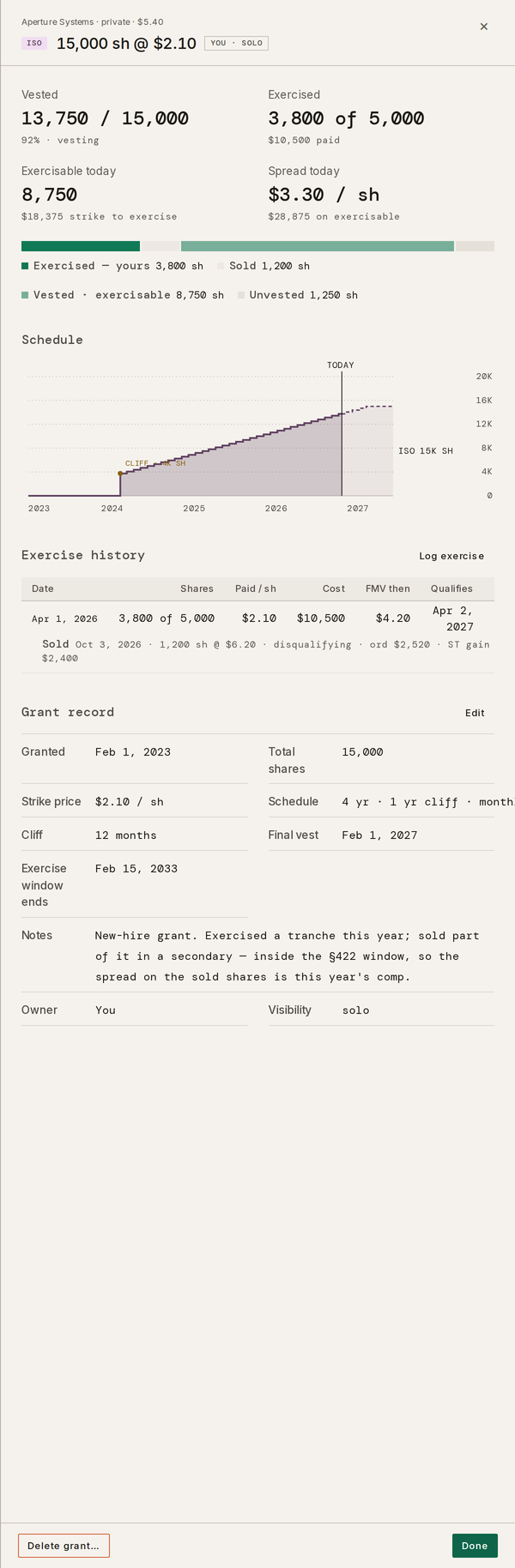
Taiga Finance shows the treatment on the lot. In the ESPP sale planner a lot sold before its date reads DISQ. UNTIL that date, with the ordinary income and the capital part in their own columns and the ST total below. A recorded sale of an ESPP lot or an ISO exercise lot keeps its line: the date, the shares, the price, then “disqualifying”, the ordinary income and the ST or LT gain, or the loss.
The band labeled This year so far carries the result as “ESPP sold”, with the line “discount recognized at sale”, and “ISOs sold”, with “disqualifying-sale spread”. A sale whose dates cannot be classified is treated as disqualifying.
Equity compensation →Key takeaways: Disqualifying disposition
- A disqualifying disposition is a sale inside either hold: two years from the grant or one year from the purchase or exercise.
- On an ESPP lot the purchase-day discount becomes ordinary income, even when the shares are sold at a loss.
- On an ISO lot the bargain element becomes ordinary income; sold below the exercise-day price, that income is capped at the gain on the sale when it is a sale on which a loss, if sustained, would be recognized.
- The income lands in the year of the sale, not the purchase. Taiga Finance marks the treatment on the lot.
Questions about Disqualifying disposition
What is a disqualifying disposition?
A sale of ESPP or ISO shares before two years have passed from the grant and one year from the purchase or exercise. The discount or spread from the purchase day is ordinary income in the year of the sale, and only the movement after that day is capital gain or loss.
What happens if ESPP shares are sold early?
The purchase-day price minus the price paid is ordinary income, whatever the sale price. The rest of the gain, or a loss, is capital, short-term if the shares were held a year or less from the purchase.
What is the difference between a disqualifying and a qualifying ISO sale?
A disqualifying sale makes the bargain element, the exercise-day price minus the strike, ordinary income, and only the gain above it capital. A qualifying sale has no ordinary income; the whole gain over the strike is long-term capital gain.
Does Taiga Finance show whether a sale is disqualifying?
Yes. The ESPP sale planner marks each lot on the chosen sale date, a recorded sale of an ESPP or ISO lot keeps its treatment and split on its row, and the This year so far band carries the ordinary income from ESPP and disqualifying ISO sales.