ESPP
Employee stock purchase plan · Section 423 planAn ESPP (employee stock purchase plan) is a payroll plan that lets employees buy their company's stock below its market price, by up to 15% under a US tax-qualified plan. Money is held back from each paycheck over an offering period and spent on shares at set purchase dates.
What is an ESPP?
A plan runs in offering periods with one or more purchase dates inside each. Contributions come out of pay, and on the purchase date the accumulated cash buys shares at the discounted price. A plan with a lookback prices the shares off the lower of the offering-start price and the purchase-day price.
An ESPP is not a grant. Shares are bought with the employee's own money, and what the company gives is the discount. The tax rules for a plan under Section 423 of the US tax code cap the discount at 15%, cap purchases at $25,000 of stock a year measured at the grant-date price, and tax the discount at the sale, not the purchase.
How much of a sale is ordinary income and how much is capital gain depends on when the shares are sold. A qualifying disposition, more than two years after the grant date and more than one year after the purchase, caps the ordinary part at the plan's discount measured at the grant-date price. A sale before either date is a disqualifying disposition. The grant date is the offering's first day when the plan caps the shares each employee may buy in that offering, and otherwise the purchase date.
How an ESPP works, with numbers
A plan gives 15% off the purchase-day price, with no lookback. Over one purchase period $4,250 is withheld from pay, and on the purchase date the stock is at $25, so the price is $21.25 and the cash buys 200 shares.
At $25 a share the lot is worth $5,000 on the day it is bought. The $750 between that and the $4,250 paid is the discount captured, and it is not taxed until the shares are sold.
- FMV on the purchase day
- $25.00
- × 85%, the purchase price
- $21.25
- $4,250 ÷ $21.25
- 200 sh
- Value at purchase-day FMV
- $5,000
- Paid
- − $4,250
- Discount captured
- $750
Why an ESPP matters
The discount is compensation, and it lands in the year of the sale. A qualifying sale treats at most the plan's discount, measured at the grant-date price, as ordinary income and the rest as long-term capital gain. A disqualifying sale treats the whole purchase-day discount as ordinary income, whatever the sale price, and only the movement after the purchase as capital gain or loss.
The shares are a position in one company, the employer, on top of a salary from the same company. The contributions also come out of take-home pay for months before any share is bought.
ESPP in Taiga Finance
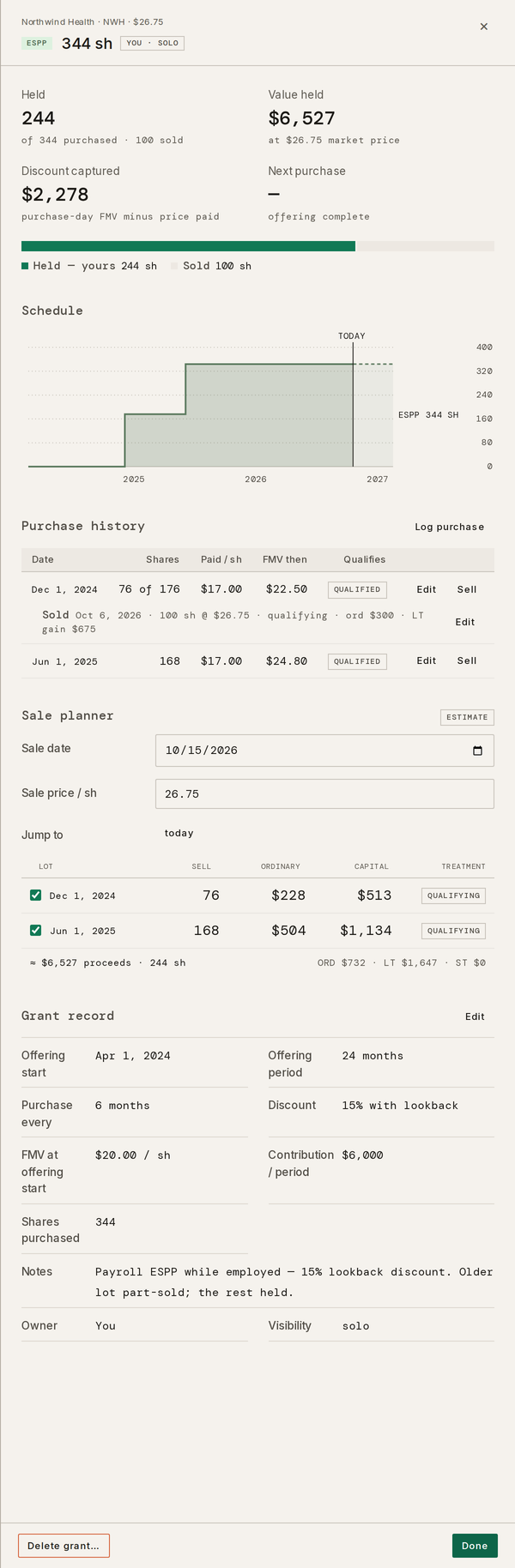
Taiga Finance shows an ESPP as a grant of its own: Held, Value held at the current price, Discount captured with the line “purchase-day FMV minus price paid”, and Next purchase. Its purchase history lists lots by date with Paid / sh, FMV then and a Qualifies column: the date a lot qualifies, or the tag QUALIFIED once it has. The grant record keeps the offering start, the purchase cadence, the discount, whether the plan has a lookback and the annual cap.
A sale planner, labeled an estimate, prices a sale of any lots on any date as ordinary income and capital gain, qualifying or not. A recorded purchase is a fact; a future purchase is only projected, at today's price, and a year whose purchases may pass the plan's annual cap, $25,000 unless the plan sets a lower one, gets a warning.
Equity compensation →Key takeaways: ESPP
- An ESPP buys company stock with payroll deductions, at up to 15% below the market price under a Section 423 plan.
- Nothing is taxed at the purchase. Some or all of the discount is ordinary income in the year the shares are sold.
- A qualifying disposition needs more than two years from the grant date and more than one year from the purchase.
- Purchases are capped at $25,000 of stock a year, measured at the grant-date price.
Questions about ESPP
What is an ESPP?
A payroll plan for buying the employer's stock at a discount. Money is withheld from each paycheck through an offering period, and on set purchase dates it buys shares at up to 15% below the market price.
How is an ESPP taxed?
Not at the purchase. When the shares are sold, part of the gain is ordinary income and the rest is capital gain. Sold more than two years after the grant date and more than one year after the purchase, the ordinary part is capped at the plan's discount measured at the grant-date price. Sold earlier, the whole purchase-day discount is ordinary income.
Does Taiga Finance track ESPP lots and their qualifying dates?
Yes. Lots are listed by purchase date with the price paid, the price that day and the date the lot qualifies, and a sale planner prices a sale on any date as ordinary income and capital gain.