Envelope budgeting
Envelope system · Cash envelopesEnvelope budgeting is a method that divides a paycheck, when it arrives, among a set of envelopes, one per kind of spending, and pays for each kind only from its envelope. In the cash form the envelopes hold bills; in the digital form the money stays in the bank and each envelope is a record of how much of the balance is set aside for it.
What is envelope budgeting?
The split happens at the moment the money arrives. A paycheck is divided in full among the envelopes, so together they hold the paycheck and nothing sits unassigned. That is what separates the method from a budget written as a list of amounts: an envelope holds the money itself, or, in the digital form, a claim on the balance.
Through the pay period an envelope answers one question: how much is left for that kind of spending. A $600 grocery envelope loses $85 at each $85 grocery trip, and what it holds is what the period still has for groceries. An empty envelope means that kind of spending waits for the next paycheck. What an envelope holds at the end of the period either goes back into the next split or stays in the envelope; the method itself doesn't decide which.
The digital form keeps the cash in a checking or savings account and the envelopes as records against the balance. The account reports one number; the envelopes divide it. This is the same idea as earmarking, where part of a balance is assigned to a purpose without being moved.
How envelope budgeting works, with numbers
A paycheck of $2,400 arrives every two weeks. It is split into five envelopes: $1,200 for rent, $400 for groceries, $250 for utilities, $150 for gas and $400 for savings. Together the envelopes hold $2,400, the whole paycheck, and $0 is unassigned.
Ten days in, $270 has been spent on groceries, and the grocery envelope holds $130. In the cash form that is the bills left in it; in the digital form it is the $400 record minus the $270 charged against it.
- Paycheck
- $2,400
- Rent
- − $1,200
- Groceries
- − $400
- Utilities
- − $250
- Gas
- − $150
- Savings
- − $400
- Unassigned
- $0
Why envelope budgeting matters
What the envelope holds is the limit, and it can be read before the spending happens. With $400 in the grocery envelope and $270 spent, $130 is the answer to how much grocery spending the period has left, without a comparison against a total or a running tally of the month.
Because the whole paycheck is assigned on arrival, the trade-offs are explicit. Putting $50 more in the gas envelope takes $50 from another one, since the envelopes together can hold only the paycheck.
Envelope budgeting in Taiga Finance
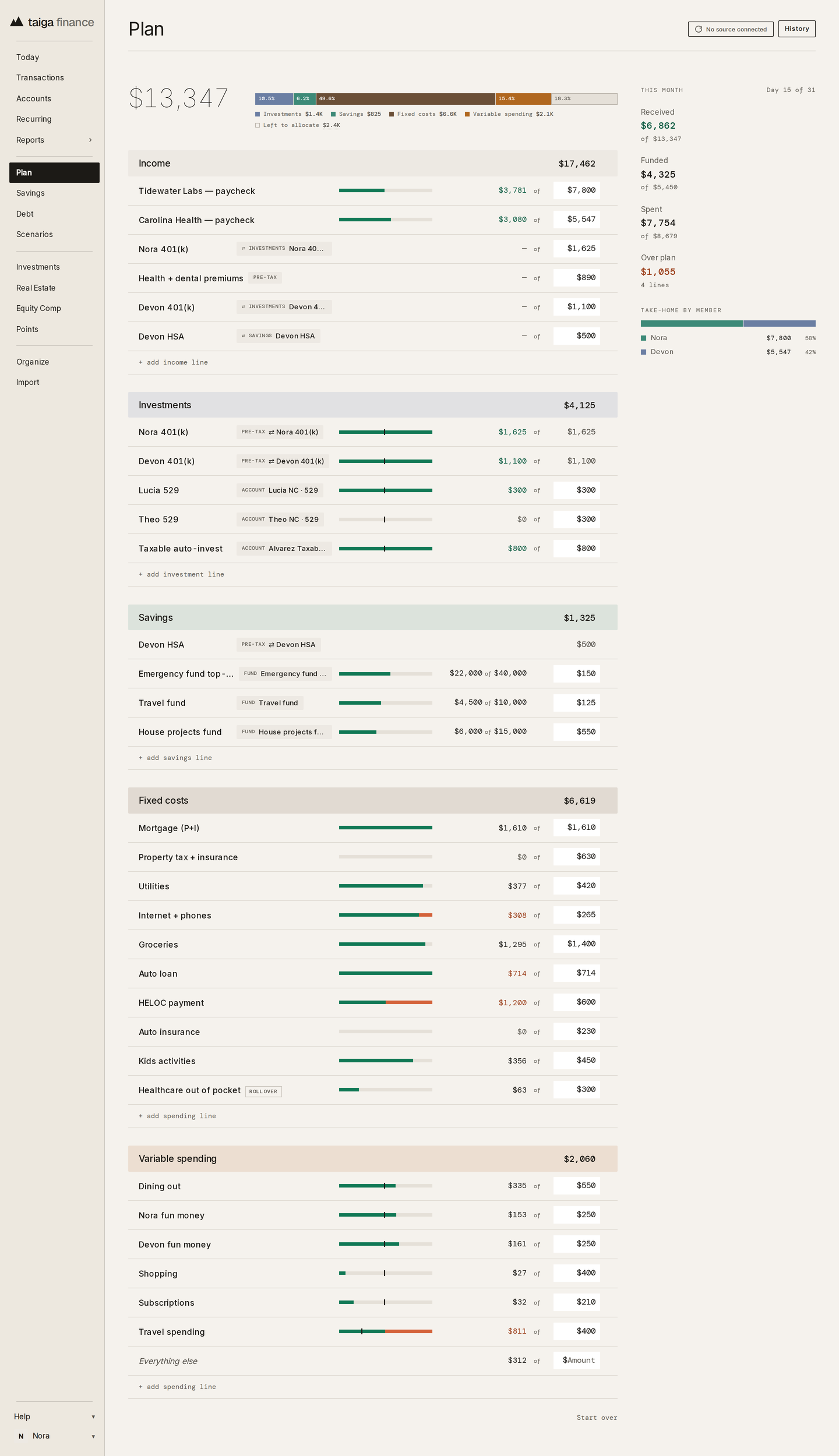
Taiga Finance has no envelopes by that name, and a spending line on the Plan does most of what one does. The line names a kind of spending and a planned amount for the month, reads “$spent of $planned” as connected transactions land against it, and, set to “Carries over”, carries its balance into the next month; “Move money” shifts an amount from one line to another. For money set aside, a savings fund on Savings claims part of a real account's balance while the money stays where it is, and the rail shows what is earmarked and what is free to allocate.
Plan & goals →Key takeaways: Envelope budgeting
- Envelope budgeting splits a paycheck among envelopes, one per kind of spending, on the day it arrives.
- The envelopes together hold the whole paycheck, so more in one envelope is less in another.
- In the digital form the money stays in the bank and each envelope is a record against the balance.
- Taiga Finance has no envelopes by that name; a Plan spending line set to Rollover does the month-to-month part, and a savings fund the set-aside part.
Questions about Envelope budgeting
What is envelope budgeting?
A method that divides a paycheck among envelopes, one per kind of spending, when it arrives, and pays for each kind only from its envelope. A $2,400 paycheck split into rent, groceries, utilities, gas and savings envelopes leaves $0 unassigned, and each envelope shows what its kind of spending has left.
Does Taiga Finance have envelope budgeting?
No, not under that name. A spending line on the Plan carries a planned amount for the month and reads what has been spent against it, and a line set to Rollover carries its balance into the next month. A savings fund claims part of a real account's balance, and the Savings rail shows what is earmarked and what is free to allocate.
What is the difference between envelope budgeting and a budget?
A budget lists an amount per kind of spending; an envelope holds the money for it, in cash or as a claim on the balance, assigned when the paycheck arrives. Both compare spending with an amount set in advance; the envelope also settles where the money is.