Fair market value
FMVFair market value is the price a share would sell for between a willing buyer and a willing seller who both know the facts. For a public company it is the market price; for a private company, whose shares don't trade, it is the figure an independent 409A valuation puts on one share of common stock.
What is fair market value?
Fair market value is a tax concept before it is a finance one. The US tax code uses it wherever a transaction has to be priced without a sale: the value of shares received on an exercise, and the lowest strike an ISO can carry.
A public company's FMV is read off the exchange. A private company has no market, so it hires an appraiser, and the appraiser's per-share figure is the 409A valuation. The tax regulations presume an independent appraisal reasonable for up to 12 months, unless later information materially affects the value. The figure is for common stock, the class employees hold; investors' preferred stock carries rights common stock does not, so its price is a different figure.
For an option holder, FMV matters on two dates. On the grant date it sets the strike. On the exercise date it sets the spread, and so the tax.
How fair market value works, with numbers
A company's 409A is $2.00 a share when an employee is granted 1,000 options, so the grant carries a $2.00 strike. Two years later a new 409A comes in at $5.00, and the employee exercises.
The spread on the exercise is $3.00 a share, or $3,000: the FMV on the exercise date minus the strike the earlier FMV set. Had the exercise happened a month before the new valuation, the earlier 409A would have priced it.
- FMV on the exercise date
- $5.00
- FMV on the grant date, the strike
- − $2.00
- Spread per share
- $3.00
- Shares exercised
- × 1,000
- Spread
- $3,000
Why fair market value matters
Everything an option is worth on paper is measured against FMV. Vested options times the gap between FMV and strike is the value of a grant; a new 409A re-prices that figure for the whole company at once, up or down.
The FMV on an exercise date is the number a later tax return is built on. It sets the bargain element, and it becomes the cost basis of the shares for an NSO. At a private company it is the 409A in force on the day, and an exercise recorded without it leaves that sum unanswerable later.
The investors' price is not the FMV. Preferred stock carries rights common stock does not, and the gap between the two prices is information about the company, not value the employee holds.
Fair market value in Taiga Finance
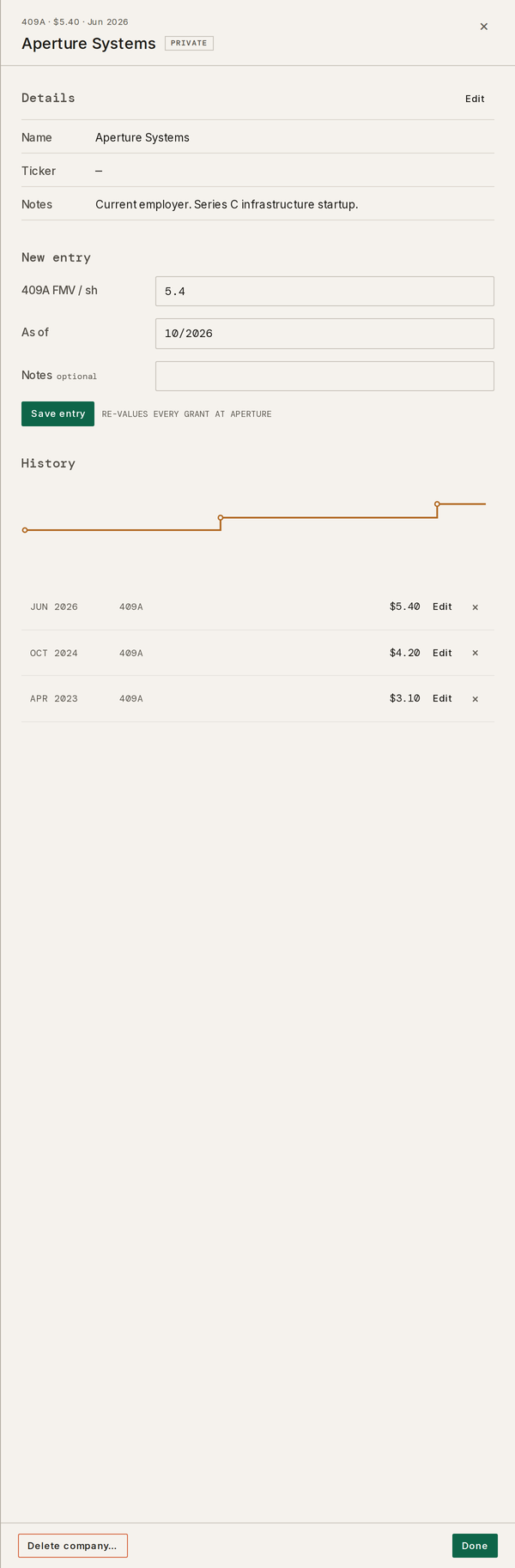
Taiga Finance prices a private company from its 409A history, entered in the company drawer as “409A FMV / sh” with an “As of” month, and each new entry re-values every grant at that company. The history lists the 409A entries and any preferred round, and the chart draws the preferred prices as reference diamonds beside the common line. A public company shows its market price in its header instead.
An exercise carries its own FMV: the log-exercise form's “FMV that day / sh” is prefilled from the 409A on that date, and the exercise history keeps it as “FMV then”. Valuations are typed in or read from a Carta file.
Equity compensation →Key takeaways: Fair market value
- Fair market value is what a share would sell for between informed, willing parties.
- For a public company it is the market price. For a private company it is the latest 409A valuation of common stock.
- FMV on the grant date sets the strike; FMV on the exercise date sets the spread.
- The price investors paid for preferred stock is not the common stock's FMV.
Questions about Fair market value
What is FMV for stock options?
The fair market value of one share of the underlying stock on a given date. It is the market price at a public company and the latest 409A valuation at a private one, and it is the figure the strike and the spread are measured against.
How is FMV set for a private company?
By an independent 409A valuation of the common stock. The tax regulations presume such an appraisal reasonable for up to 12 months, unless later information materially affects the value, and the appraiser's per-share figure is the FMV until the next one replaces it.
What is the spread at current FMV?
The latest FMV minus the strike, per share, times the vested options. On 1,000 options with a $2.00 strike at a $5.00 FMV, it is $3,000. It is a paper figure until an exercise fixes it on a date.
Where does Taiga Finance get a share's FMV?
A private company's FMV is its 409A history, typed in or read from a Carta file, and a public company's header shows its market price. An exercise records the FMV on its own date.