Minimum payment
Minimum dueA minimum payment is the smallest amount a lender accepts on a debt each period without treating it as missed: on a credit card a percentage of the balance or a stated floor, whichever is larger, and on an installment loan the scheduled payment. Part of it covers the month's interest, and only the rest reaches the balance.
What is a minimum payment?
A card agreement sets the minimum as a formula. A common shape is a percentage of the balance, such as 2% or 3%, or a floor such as $25 when the percentage comes to less than that; some issuers state it as 1% of the balance plus the month's interest and fees instead. The statement prints the figure as the minimum due, with a due date. On an installment loan, such as an auto loan or a student loan, the minimum is the scheduled payment the lender set when the loan was written, and it does not change with the balance.
The month's interest is the balance times the monthly rate, and it is charged whatever is paid. The minimum includes that interest, so the part of it that reaches the balance is the minimum less the interest.
Since the Credit CARD Act of 2009, a card statement carries a minimum payment warning: how many years the balance takes to pay off at the minimum alone, and what that costs, beside the monthly amount that clears it in three years.
How a minimum payment works, with numbers
A credit card carries a $6,000 balance at a 21% APR, and its agreement sets the minimum at 3% of the balance. The monthly rate is 21% divided by 12, or 1.75%, so the month's interest is $105. The minimum is 3% of $6,000, or $180. Of the $180, $105 covers the interest and $75 reaches the balance, which ends the month at $5,925. Nothing new is charged, and the interest is charged on the month's opening balance; the figures are this example's arithmetic.
The next month's minimum is worked from the smaller balance: 3% of $5,925 is $177.75, and $103.69 of it is interest. Both the minimum and the amount reaching the balance shrink a little each month.
- Balance
- $6,000
- Minimum, 3% of $6,000
- $180
- Interest, 1.75% of $6,000
- − $105
- To the balance
- $75
Why a minimum payment matters
The minimum decides the least the balance can fall in a month. In the example, $75 of a $180 minimum reaches the balance, so a payoff at the minimum alone runs for years, and the balance falls more slowly as the minimum shrinks with it. Any amount above the minimum reaches the balance whole, since the month's interest is already covered.
The gap between the minimum's percentage and the monthly rate is what moves the balance. At 3% and 1.75%, 1.25% of the balance is retired each month. A minimum set at or below the month's interest leaves the balance where it was, or larger.
When several debts are paid from one monthly amount, the minimums come out first and the rest is the surplus that a payoff order directs. A monthly amount below the minimums added together does not fund the debts as agreed.
Minimum payment in Taiga Finance
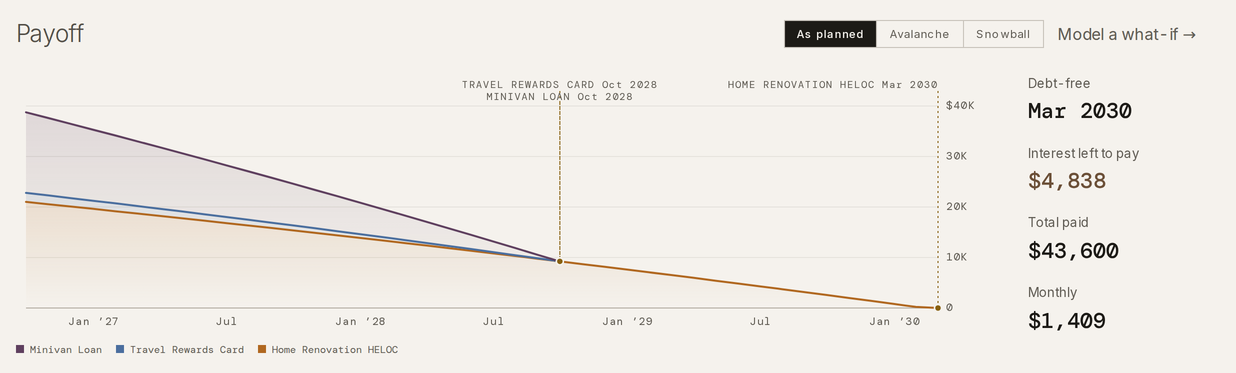
On the Debt page a debt carries its minimum. The “Track a debt” drawer's Terms section takes it as “Minimum payment ($)”, with the hint “The payoff plan falls back to your budgeted payment when blank.” The debt's drawer reads the figure in the caption under the balance, as in “22.74% APR · $121/mo minimum”, and holds it in a “Minimum” row under Details. The rail adds the minimums up as “Minimum monthly payment” beside “Monthly payments”, what the plan pays, for the payoff plan or for all debts as the scope toggle is set.
A debt's row shows its planned monthly payment, “/mo”. In the payoff readout's “As planned” view each debt is paid its own planned payment, its minimum when none is planned, and the readout's working splits the month into “Minimums”, “Surplus” and the “Monthly” total. A “Monthly budget” below the minimums added together projects nothing; the page says so, with a “Set budget to” button that raises the budget to that sum. In the “Debt payoff” calculator, “This month's payments” lists where the month's money goes.
Plan & goals →Key takeaways: Minimum payment
- A minimum payment is the smallest amount a lender accepts on a debt each period; on a card it is a percentage of the balance or a floor, on an installment loan the scheduled payment.
- Part of the minimum covers the month's interest, and only the rest reaches the balance: $105 of a $180 minimum on a $6,000 balance at 21% APR.
- A card's minimum shrinks with the balance, so the amount reaching the balance shrinks too.
- Taiga Finance keeps a minimum on each debt, totals them as “Minimum monthly payment” on the Debt page, and pays a debt its minimum when no payment is planned for it.
Questions about Minimum payment
What is a minimum payment on a credit card?
The smallest payment the card issuer accepts for the month without treating the account as past due. The agreement sets it as a percentage of the balance, such as 2% or 3%, or a floor such as $25, whichever is larger; some issuers set it as 1% of the balance plus the month's interest and fees. The statement prints it as the minimum due.
How much of a minimum payment goes to interest?
The month's interest, which is the balance times the monthly rate; the rest reaches the balance. On a $6,000 balance at 21% APR with a 3% minimum, the minimum is $180, the interest is $105 and $75 reaches the balance.
What happens in Taiga Finance when a debt has no planned payment?
The payoff plan pays it its minimum on file, held at that amount until it is paid off. A monthly budget below all the minimums added together projects nothing until it is raised; the page offers a button that sets the budget to that sum.