Principal vs interest
Principal and interest · P+IPrincipal vs interest is the split inside a loan payment: the interest is the lender's charge for the month, worked from the balance still owed and the rate, and the principal is the rest of the payment, the part that reduces the balance. A payment quoted as principal and interest, or P+I, is the two together, without escrow.
What is principal vs interest?
A month's interest is the balance owed at the start of the month times the yearly rate divided by 12. It is charged whatever the payment is. Whatever the payment carries beyond that interest is principal, and only the principal changes what is owed.
The payment on a fixed-rate loan stays the same from month to month, so the split moves with the balance. A large balance means a large interest charge and little left for principal; as the balance falls the interest falls with it and more of the same payment reaches the balance. A larger payment in any month changes only the principal side, since the interest for that month was already fixed by the balance.
A servicer's monthly bill can be larger than the P+I. The difference is escrow, the amount collected toward property taxes and insurance, which is neither principal nor interest.
How principal vs interest works, with numbers
A mortgage has a balance of $250,000 at a 7.2% rate, and its fixed payment is $1,696.97. The month's interest is $250,000 times 0.6%, the yearly rate divided by 12, which is $1,500. The rest of the payment, $196.97, is principal, and the balance after the payment is $249,803.03.
The same $1,696.97 payment on the same loan, once the balance has fallen to $100,000, carries $600 of interest and $1,096.97 of principal. Nothing about the payment changed; the balance under it did.
- Balance
- $250,000
- Monthly rate (7.2% ÷ 12)
- 0.6%
- Interest, this month
- $1,500.00
- Payment
- $1,696.97
- Principal, this month
- $196.97
Why principal vs interest matters
The split says what a payment did. In the example, $1,696.97 left the account and the debt fell by $196.97; the other $1,500 was the month's cost of owing $250,000. A payment's size and its effect on the balance are two different figures, and the split is the link between them.
It is also the figure that equity is built from. On a home, the principal side of each payment is what moves the mortgage balance, and so the equity, from one month to the next.
Principal vs interest in Taiga Finance
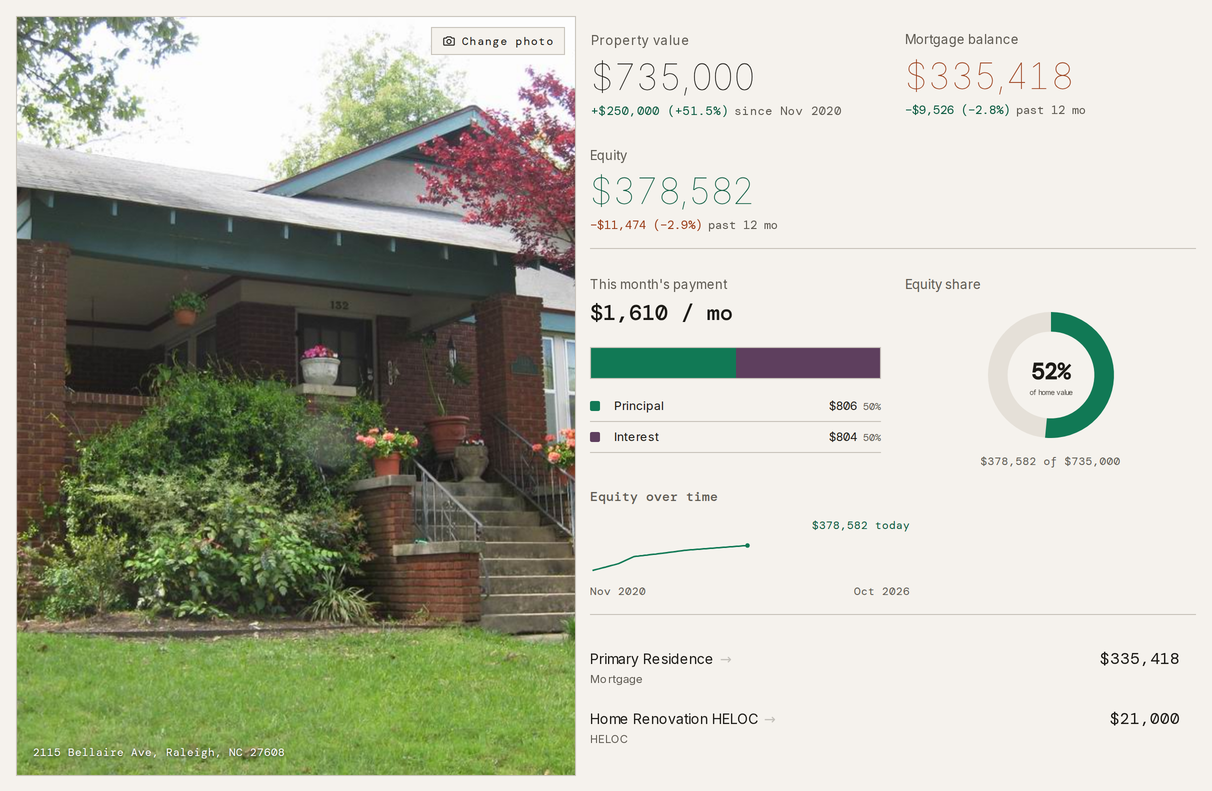
Taiga Finance shows the split for a mortgage on the property's page. “This month's payment” is drawn as a bar with a “Principal” segment and an “Interest” segment, each with its dollar figure and its share of the payment; a loan with an escrow figure entered gets an “Escrow” segment as well. The interest is the current balance times the rate on the loan divided by 12, and the principal is the scheduled monthly P&I less that interest. The property's “Property summary” adds up the two sides over the life of the loan so far as “Principal paid to date” and “Interest paid to date”, beside “Interest remaining”.
The loan's card on the property lists the scheduled payment as “P&I” with “/ mo”, and the same figure is the mortgage's monthly amount on the Debt page. On the Plan, a mortgage payment is a fixed spending line the household names itself, such as “Mortgage (P+I)”; the Plan shows what was spent against the line's planned amount and does not split it. For a card or loan in the payoff plan, the drawer's “Payoff schedule” lists the first two months as “Mo 1 · int $91 → $4,758”: the month's interest and the balance the payment leaves.
The public mortgage payoff calculator →Key takeaways: Principal vs interest
- A month's interest is the balance owed times the yearly rate divided by 12; the principal is the rest of the payment, and only it reduces the balance.
- On a fixed-rate loan the payment holds still and the split moves: as the balance falls, less of the same payment is interest and more is principal.
- P+I leaves out escrow. A servicer's bill can be larger than the principal and interest together.
- Taiga Finance draws a mortgage's “This month's payment” as a bar split into “Principal” and “Interest”, each with its dollar figure and share.
Questions about Principal vs interest
What is the difference between principal and interest on a loan?
The interest is the month's charge for the balance still owed, the balance times the yearly rate divided by 12. The principal is the rest of the payment, the part that reduces the balance. On a $250,000 mortgage at 7.2%, a $1,696.97 payment is $1,500 of interest and $196.97 of principal.
Why is so much of my mortgage payment interest?
Because the interest is charged on the whole balance, and early in a loan the balance is large. At $250,000 and 7.2%, the month's interest is $1,500 before any of the payment reaches the balance. Once the balance is $100,000, the same payment carries $600 of interest and $1,096.97 of principal.
How does Taiga Finance show principal versus interest?
On a property's page, as a “This month's payment” bar split into “Principal” and “Interest”, each with its dollar figure and its share of the payment. The interest is the current balance times the loan's rate divided by 12; the principal is the scheduled P&I less that interest.