Payoff date
Debt-free date · Projected payoffA payoff date is the month a debt's balance reaches zero at a given payment and rate. It is a projection: the balance, the rate and the amount paid each month fix it, and a change in the payment or the rate moves it.
What is a payoff date?
A debt is paid off when its balance is zero. The month that happens is the payoff date. For a loan with a fixed term it is set at the start; for a card or a line with no term, it depends on what is paid each month against a balance that accrues interest.
Month by month, the balance grows by the interest charged and shrinks by the payment. The payment above the interest is what retires principal, and the next month's interest is charged on the smaller balance, so an unchanged payment retires a little more each month. Counting the months until the balance is gone gives the payoff date.
The date follows the inputs. A larger payment or a lower rate brings it forward; a smaller payment, a higher rate or a new charge pushes it back. The date the schedule projects at the start holds only if the payments and the rate hold.
How a payoff date works, with numbers
A $6,000 card balance at 18% APR, a 1.5% monthly rate, is paid $200 a month, with nothing new charged and the rate fixed. The first month's interest is $90, so $110 of the $200 reaches the balance. The payment retires a little more each month as the interest falls, and the balance reaches zero with the 41st payment, after three years and five months of payments. The interest over that time comes to $2,031.
The same balance at $300 a month reaches zero with the 24th payment, 17 months sooner, and the interest comes to $1,187. At $200 a month and 24% APR instead of 18%, it takes 47 payments and $3,255 of interest. The figures here are this example's arithmetic; the planner works out its own for the debts entered in it.
- Balance
- $6,000
- Monthly rate (18% ÷ 12)
- 1.5%
- Interest, month 1
- $90
- Payment
- $200
- To principal, month 1
- $110
- Months to zero at $200
- 41
- Months to zero at $300
- 24
- Months sooner at $300
- 17
Why a payoff date matters
The payoff date turns a rate and a payment into a month on the calendar. In the example, the same $6,000 balance is 41 months of $200 or 24 months of $300; the difference in interest, $844, is the cost of the 17 extra months.
It also shows what each input is worth. Adding $100 to the payment takes 17 months off; adding six points to the rate adds six months and $1,224 of interest at the $200 payment. With several debts, the last payoff date is the month the household is out of debt.
Payoff date in Taiga Finance
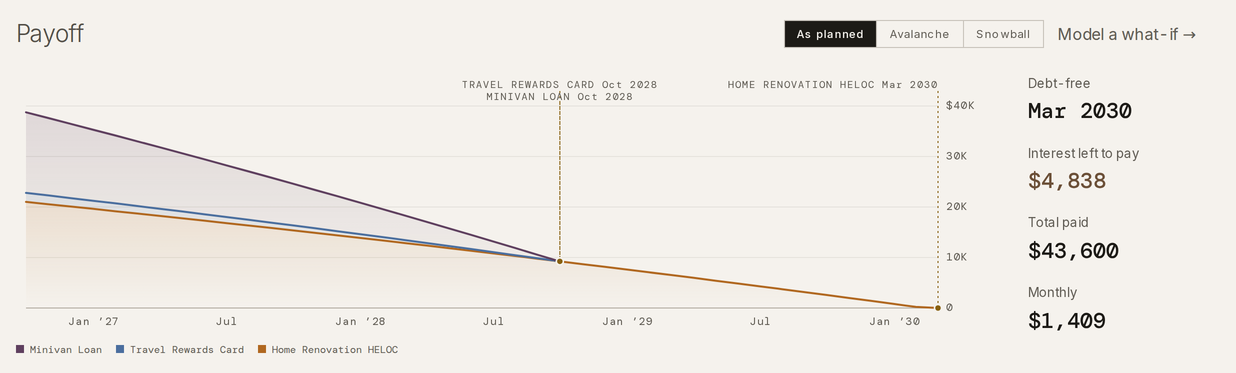
On the Debt page, each debt's row reads its projected payoff month once the payoff plan reaches payoff for it, and “—” for a debt that is not in the plan or whose payoff the plan does not reach. The debt's drawer holds a “Payoff schedule” that lists the first months' interest and closing balance and ends in “Interest left to pay”. A debt in the plan with no rate on file is paid its minimum and has no payoff month, no schedule and no interest figure; while one is in the plan, the plan's “Debt-free” month and “Interest left to pay” read no figure and give the reason.
The Debt page's payoff readout, and the “Debt payoff” calculator under Scenarios, run the debts in the plan forward together at a “Monthly budget” and a “Strategy”, and read “Debt-free”, the month the last debt clears, beside “Interest left to pay”. The “Payoff order” chart draws one lane per debt out to that debt's own month, and “Debt-free date by extra monthly payment” lists the debt-free date at a few larger monthly amounts. An “Extra monthly” or “One-time payment” added to the plan moves “Debt-free” and “Interest left to pay”, with the change against the plan without the moves beside each. A month's interest is the balance times the rate in effect, divided by 12; nothing new is charged and the monthly amount holds for the whole projection. A mortgage's own payoff date is on the property page, in the mortgage payoff planner, as “Paid off”.
Scenarios & reports →Key takeaways: Payoff date
- A payoff date is the month a debt's balance reaches zero at a given payment and rate; it moves when either one does.
- In the example, a $6,000 balance at 18% APR is 41 months of $200 or 24 months of $300, and the smaller payment costs $844 more interest.
- A higher rate pushes the date back at the same payment: 24% instead of 18% adds six months to the $200 payoff.
- Taiga Finance projects a month per debt in the ledger's “Payoff” column and one “Debt-free” month for the whole payoff plan, and projects no month for a debt in the plan that has no APR.
Questions about Payoff date
What is a payoff date on a debt?
The month the balance reaches zero at a given payment and rate. It is worked forward month by month: interest is charged on the balance, the payment above the interest retires principal, and the count of months until nothing is owed gives the date.
How does a bigger payment change the payoff date?
It takes months off and cuts the interest. A $6,000 balance at 18% APR reaches zero in 41 months at $200 a month and in 24 months at $300 a month, with $844 less interest.
Does Taiga Finance show when I will be debt-free?
Yes. The Debt page's payoff plan reads one “Debt-free” month for the debts in it together, at the monthly budget and strategy set, and each row's “Payoff” column reads that debt's own month. While a debt in the plan has no APR on file, that debt is paid its minimum with no month of its own, and “Debt-free” reads no month until a rate is entered.