Pay period
Pay schedule · Pay frequencyA pay period is the stretch of work one paycheck covers, and the pay schedule is how often those paychecks land: weekly, biweekly, semi-monthly or monthly. On a biweekly schedule, two months of the year hold three paychecks instead of two.
What is a pay period?
The four common schedules are weekly, 52 paychecks a year; biweekly, every 14 days, 26 a year; semi-monthly, on two set dates such as the 15th and the last day, 24 a year; and monthly, 12 a year. Semi-monthly and monthly follow the calendar, so each month holds the same number of paychecks. Weekly and biweekly follow a count of days, and the count drifts through the calendar.
Two biweekly paychecks span 28 days, and the shortest month is 28 days. A month holds three paychecks when the first lands early enough for a third to fit 28 days later: on the 1st, 2nd or 3rd of a 31-day month, the 1st or 2nd of a 30-day month, or the 1st of a 29-day one. Which two months those are depends on the pay date and the year, so they move from year to year.
The third paycheck is not additional pay. The 26 biweekly paychecks add up to the same annual pay however they fall across the months; the third paycheck is that pay landing unevenly across the calendar.
How a pay period works, with numbers
A household is paid $1,800 every other Friday. A month with two paydays brings in $3,600, and a month with three brings in $5,400. On a schedule of 26 paychecks a year, ten months hold two and two hold three.
Against the ten two-paycheck months, each of the two three-paycheck months brings in $1,800 more, or $3,600 across the year.
- Paycheck, every 14 days
- $1,800
- A two-paycheck month
- $3,600
- A three-paycheck month
- $5,400
- Above a two-paycheck month
- $1,800
- Three-paycheck months a year
- × 2
- Above two-paycheck pay, across the year
- $3,600
Why a pay period matters
A monthly budget is set against the calendar month, and the bills that fill it mostly land once a month. Pay on a semi-monthly or monthly schedule arrives in the same rhythm. Pay on a biweekly schedule arrives in a rhythm of 14 days, so the month's income is $3,600 in ten months and $5,400 in two, while the bills stay the same.
Which months hold three paydays is set by the calendar, so it can be read ahead of time from the pay date, before the month arrives.
Pay period in Taiga Finance
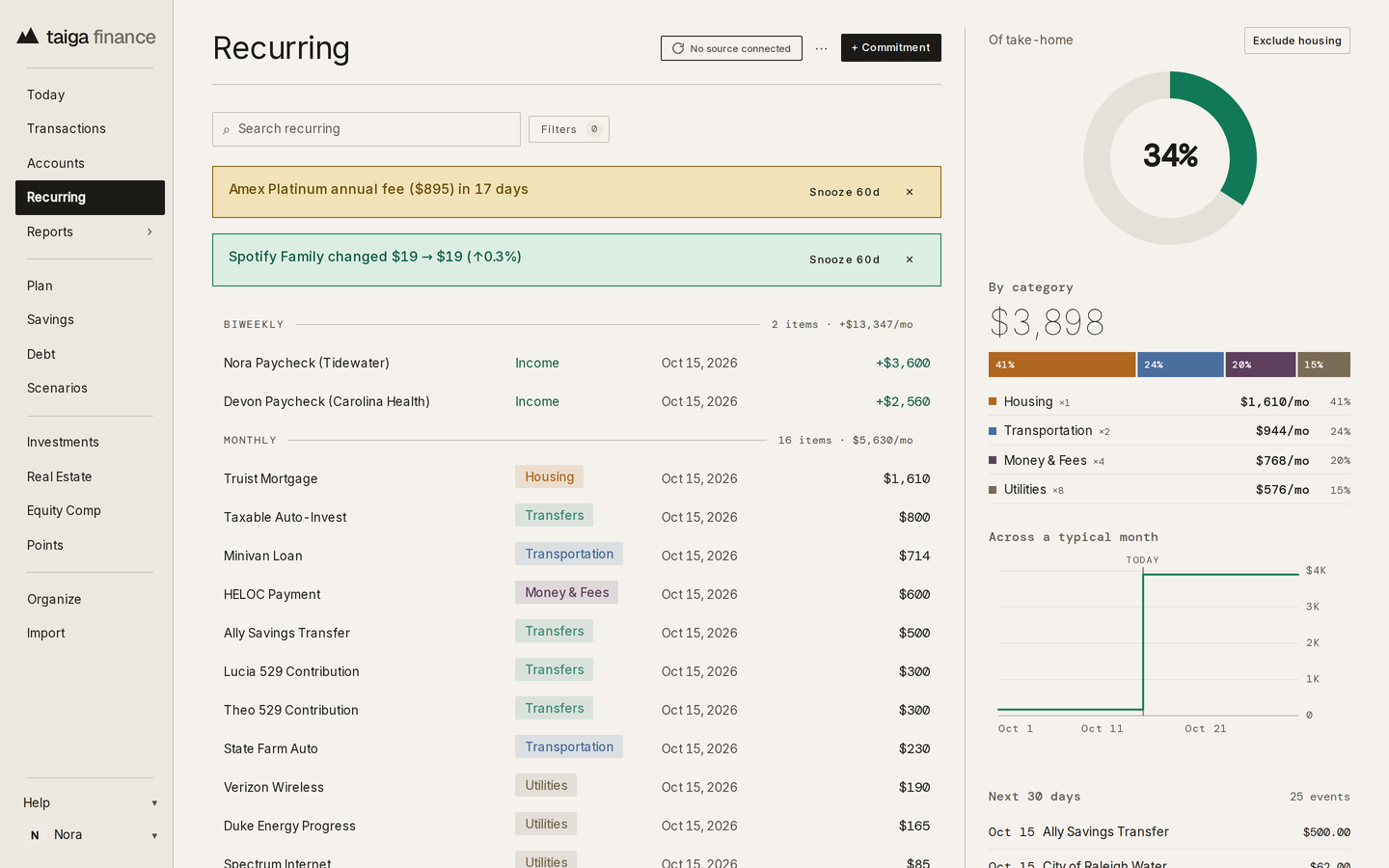
Taiga Finance's Recurring page lists paychecks as commitments alongside bills and subscriptions, in bands by cadence: “Weekly”, “Biweekly”, “Semi-monthly”, “Monthly”, then the longer intervals and “Irregular” last. A paycheck row shows the merchant, its “Income” category, the next expected date and the estimated amount with a leading +. The band's header counts its rows and states their monthly figure, so a Biweekly band of one $1,800 paycheck reads as $3,900 a month, the amount times 26 over 12, while the deposits in any one month come to $3,600 or $5,400.
The Plan is monthly. It steps a month at a time, and each income line carries one expected amount for the month; the Plan's take-home is the sum of those amounts across the paycheck lines. An income line's meter reads the deposits that landed against that expected amount. There is no pay-period view of the Plan.
Plan & goals →Key takeaways: Pay period
- A pay period is the stretch of work one paycheck covers; the pay schedule is how often paychecks land, from weekly to monthly.
- Semi-monthly and monthly pay follow the calendar; weekly and biweekly pay follow a count of days and drift through it.
- On a biweekly schedule, ten months hold two paychecks and two hold three; the third paycheck is the same annual pay landing unevenly.
- Taiga Finance bands paychecks by cadence on the Recurring page and states each band's monthly figure; the Plan is set a month at a time.
Questions about Pay period
How many paychecks are in a month when pay is biweekly?
Two in ten months of the year and three in the other two. Biweekly is every 14 days, 26 paychecks a year, and 12 months of two would only be 24.
Which months have three paychecks?
One whose first payday lands early enough for a third to fit 28 days later: the 1st, 2nd or 3rd of a 31-day month, the 1st or 2nd of a 30-day month, or the 1st of a 29-day one. The pay date and the year decide which two, so they move from year to year.
Does Taiga Finance budget by pay period?
No. The Plan is monthly: it steps a month at a time, and each income line carries one expected amount for the month, with the deposits that landed read against it. The Recurring page is where a paycheck's schedule shows, in a band by cadence with the band's monthly figure in its header.