Take-home pay
Net payTake-home pay is the amount of a paycheck that reaches the bank account: gross pay minus the taxes withheld and the pre-tax deductions taken out before the deposit. It is the figure a monthly plan's investments, savings and spending are measured against.
What is take-home pay?
Gross pay is what the job pays before anything comes out of it. Withholding is the tax the employer sends on the worker's behalf: federal income tax, Social Security and Medicare, and state income tax where there is one. A pre-tax deduction leaves the paycheck before the tax is worked out, such as a 401(k) contribution, an HSA contribution or a health insurance premium.
Take-home pay is what is left after both. It is the number on the deposit, and it is smaller than gross pay by the withholding and the deductions together.
A pre-tax deduction is money that was earned and then set aside or spent before it could reach the account. A 401(k) contribution sits in the 401(k); a premium bought the insurance.
How take-home pay works, with numbers
A salary of $96,000 a year is $8,000 a month of gross pay. The paycheck sends $480 to a 401(k) and $250 to health premiums before tax, and $1,670 is withheld for federal, state and payroll taxes. The deposit is $5,600.
The $8,000 earned splits three ways: $730 set aside or spent pre-tax, $1,670 in tax, and $5,600 of take-home. A plan built on take-home starts from the $5,600, and the $480 in the 401(k) is a contribution the deposit never shows.
- Gross pay, monthly
- $8,000
- 401(k) contribution, pre-tax
- − $480
- Health premiums, pre-tax
- − $250
- Taxes withheld
- − $1,670
- Take-home pay
- $5,600
Why take-home pay matters
Take-home pay is the income a month is planned from. Spending lines, savings and investment contributions come out of the deposit, so a share of income is a share of the $5,600, and a share of the $8,000 would count money that never arrived.
Pre-tax contributions sit outside that figure. The $480 to the 401(k) is a contribution toward retirement that the deposit does not show, so a plan that counts only what leaves the account after the deposit understates what is being set aside by that amount.
Take-home pay in Taiga Finance
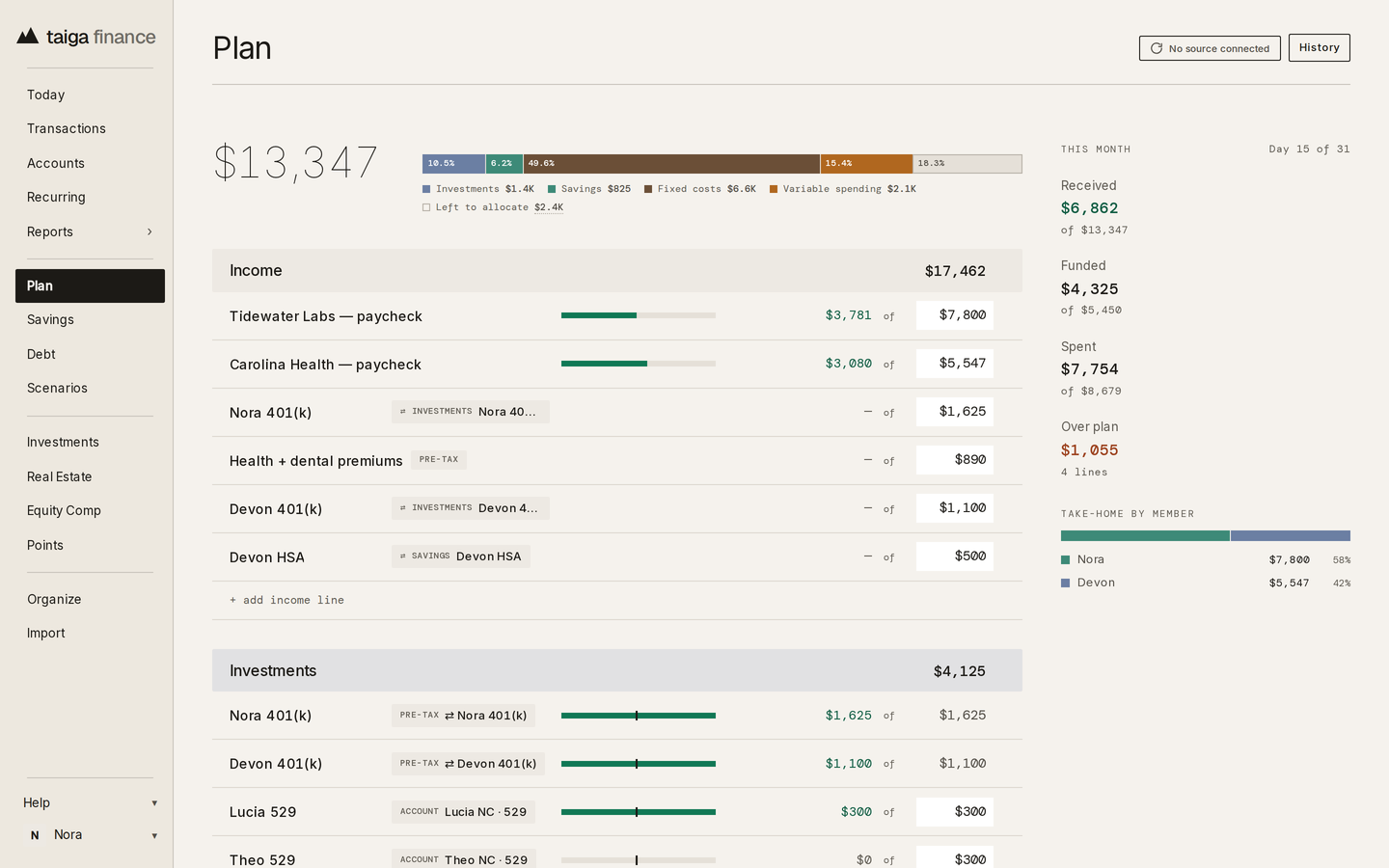
On the Plan, Taiga Finance's Income section holds one line per paycheck, each with a monthly expected amount and, through the month, a meter of what has been received against it. The band at the top of the Plan is drawn against the take-home pay: the sum of the paycheck lines' monthly amounts, with the planned Investments, Savings and Spending as its segments.
A pre-tax deduction is a line of its own in Income, marked “pre-tax”, with a “Counts toward” choice of Investments, Savings or Neither. One that counts toward a section is marked with that section's name, and the section carries a matching row. The band's working lists “Total income” and “Before take-home”, the deductions, above the take-home. No gross figure is typed in: take-home comes from the paycheck lines, and each deduction is its own line.
The Recurring page's “Of take-home” gauge divides monthly recurring outflow by the same take-home. When the Plan has no paycheck lines, it uses the recurring income it has found instead.
Plan & goals →Key takeaways: Take-home pay
- Take-home pay is gross pay minus the taxes withheld and the pre-tax deductions, the amount that reaches the account.
- A pre-tax deduction is earned money set aside or spent before the deposit, so the deposit is smaller by that amount.
- A monthly plan built on take-home pay measures investments, savings and spending against the deposit, not against gross pay.
- In Taiga Finance, take-home is the sum of the paycheck lines on the Plan, and a pre-tax deduction is a separate Income line that can count toward Investments or Savings.
Questions about Take-home pay
What is the difference between gross pay and take-home pay?
Gross pay is what the job pays before anything is taken out. Take-home pay is what reaches the account after taxes are withheld and pre-tax deductions such as a 401(k) contribution or a health premium come out. In the example, $8,000 of gross pay becomes a $5,600 deposit.
How does Taiga Finance know my take-home pay?
From the Income section of the Plan. A paycheck is a line with a monthly expected amount, and the rail's Income row adds those up. There is no gross figure to type in; a pre-tax deduction is a line of its own, tagged Pre-tax.
Does Taiga Finance count a 401(k) contribution from my paycheck as savings?
When the pre-tax line's “Counts toward” is set to Investments or Savings, yes. That section carries a matching row, and the rail shows the amount as “+$X pre-tax” beside the section's share of take-home.