PITI
Principal, interest, taxes and insurance · Mortgage payment with escrowPITI is a mortgage payment counted in full: principal, interest, property taxes and homeowners insurance. The principal and interest repay the loan; the taxes and insurance are usually collected by the servicer with the monthly payment into an escrow account, which pays those bills when they come due.
What is PITI?
The four letters are the parts of a typical monthly mortgage bill. Principal and interest, P&I, are the loan's own payment, set by the balance, the rate and the term. Taxes and insurance are the property's costs: the servicer divides the year's property tax and homeowners insurance premium by 12, collects that beside the P&I, holds it in escrow and pays the county and the insurer from it.
The two halves move differently. On a fixed-rate loan the P&I stays the same until the loan is paid off. The escrow part follows the tax bill and the premium: the servicer reviews the escrow account once a year and resets the monthly amount, so the bill on a fixed-rate mortgage can still go up or down.
Two costs sit at the edges. Mortgage insurance, PMI on a conventional loan, is usually billed with the monthly payment where a loan carries it. HOA dues go to the association rather than the servicer, though a lender counts them in the housing payment it underwrites. A loan with no escrow account leaves the owner to pay the taxes and insurance directly, and the monthly bill is the P&I alone.
How PITI works, with numbers
A $400,000 mortgage at 6.5% over 30 years has a principal-and-interest payment of $2,528.27. The property tax is $6,000 a year and the homeowners insurance $1,800 a year, so the servicer collects $500 and $150 a month into escrow. The bill is $2,528.27 plus $650, which is $3,178.27. In the first month, $2,166.67 of it is interest, $650 is escrow, and $361.61 reduces the balance.
The next year the county reassesses the house and the tax rises to $6,600. The escrow review resets the monthly escrow to $700, and the bill to $3,228.27; the P&I is still $2,528.27. A loan that also carried mortgage insurance of $1,200 a year would have $100 a month more billed with it.
- Loan, 6.5% over 30 years
- $400,000
- Principal and interest
- $2,528.27
- Property tax ($6,000 ÷ 12)
- $500.00
- Homeowners insurance ($1,800 ÷ 12)
- $150.00
- PITI
- $3,178.27
Why PITI matters
PITI is the figure that leaves the checking account. In the example, a schedule quoting $2,528.27 describes a $3,178.27 bill, and a housing budget built on the P&I alone is $650 a month short of it.
It is also the payment a lender works with. The front-end ratio on a mortgage application divides the full housing payment, taxes and insurance included, by gross monthly income, and the debt-to-income ratio counts the payment the same way. And it holds the part of owning a home that a fixed rate does not fix: in the example the bill rose $50 a month with no change to the loan.
PITI in Taiga Finance
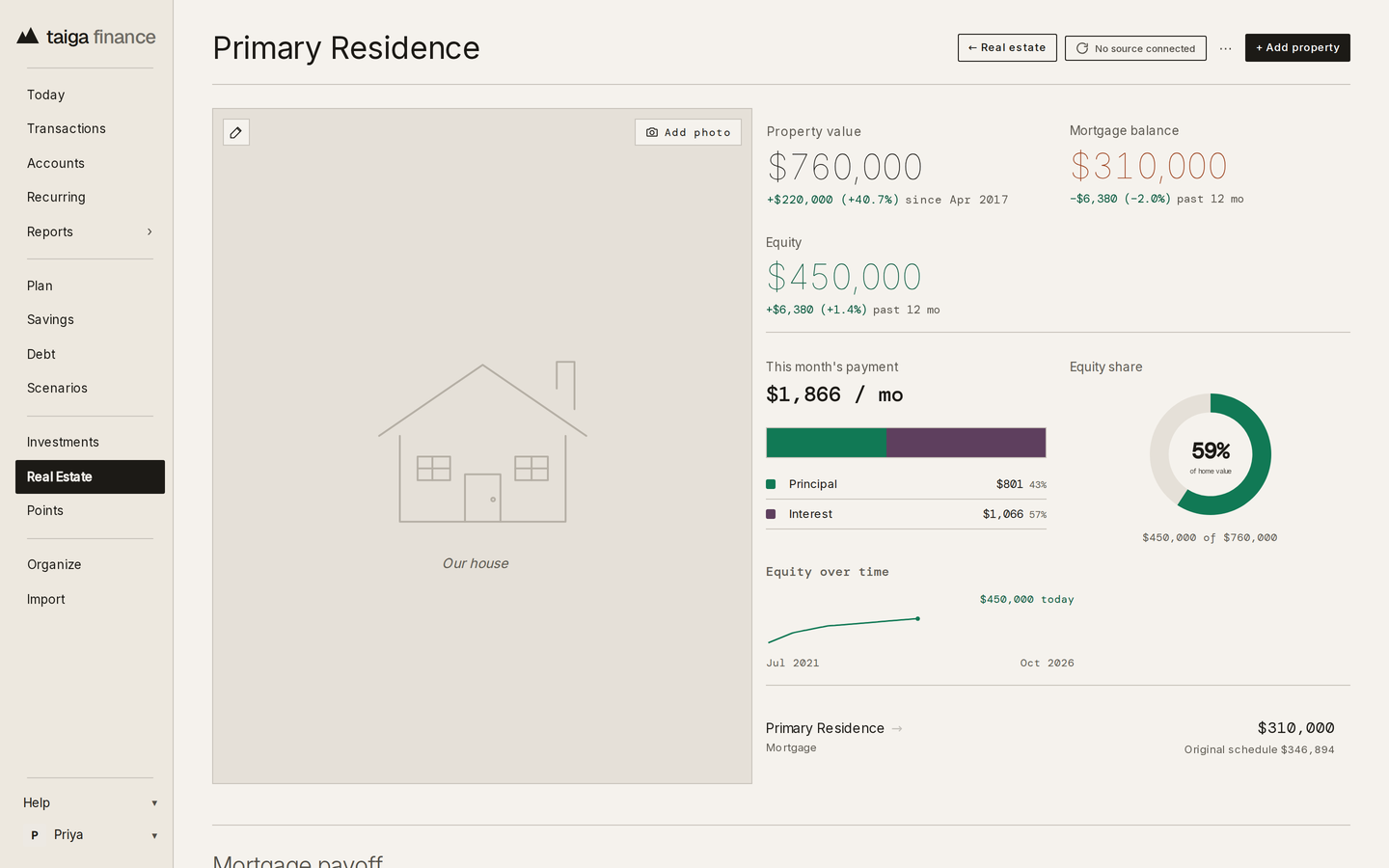
Taiga Finance shows a mortgage's payment on the property's page as “This month's payment”: the scheduled P&I plus the monthly escrow entered on the loan, drawn as a bar split into “Principal”, “Interest” and, when an escrow figure is entered, “Escrow”, each with its dollar figure and its share. The interest is the current balance times the loan's rate divided by 12, and the principal is the P&I less that interest. The loan's card lists the payment as “P&I” with “/ mo” and, when there is one, the escrow as an “Escrow” row of its own.
Escrow is one monthly figure, entered on the loan's terms as “Escrow”; Taiga Finance does not hold the tax and the insurance as separate amounts. On the Debt page the mortgage's monthly amount is the P&I. The mortgage payoff planner, and the public calculator built on the same arithmetic, project principal and interest only, with a note, “Principal and interest only”, under “What this plan doesn't capture”.
The public mortgage payoff calculator →Key takeaways: PITI
- PITI is principal, interest, property taxes and homeowners insurance: the full monthly mortgage bill when the servicer collects the taxes and insurance through escrow.
- In the example, a $2,528.27 P&I payment becomes a $3,178.27 bill once $650 of monthly escrow is added.
- On a fixed-rate loan the P&I holds still; the escrow part moves with the tax bill and the insurance premium and is reset at the servicer's yearly review.
- Taiga Finance draws “This month's payment” as the P&I plus the escrow entered on the loan; its payoff planner and the public calculator cover principal and interest only.
Questions about PITI
What does PITI stand for in a mortgage payment?
Principal, interest, taxes and insurance. The principal and interest repay the loan; the property taxes and homeowners insurance are collected monthly into escrow and paid from it. A $400,000 loan at 6.5% over 30 years has a $2,528.27 P&I payment, and with $6,000 of property tax and $1,800 of insurance a year the PITI is $3,178.27.
Why did my mortgage payment go up if my rate is fixed?
On a fixed-rate loan the principal and interest stay the same, so a change in the bill comes from what is collected beside them, most often the escrow. The servicer resets it at a yearly review to cover the latest tax bill and premium. In the example, a property tax rise from $6,000 to $6,600 a year lifts the bill by $50 a month, to $3,228.27.
Does Taiga Finance include taxes and insurance in a mortgage payment?
On the property's page, as one figure: “This month's payment” adds the monthly escrow entered on the loan to the P&I and shows it as an “Escrow” segment. The tax and the insurance are not entered apart. The mortgage payoff planner and the public calculator project principal and interest only.