Concentration risk
Concentrated position · Single-stock riskConcentration risk is the exposure a portfolio carries when a large share of its value sits in one holding, one sector or one company, so that a move in that one thing moves the whole. It is common with equity compensation, where vested RSUs and ESPP shares are all the same employer's stock.
What is concentration risk?
A portfolio spread across many holdings moves with the market as a whole. When one holding is a large share of the total, the portfolio also moves with that one holding, by the share it makes up. A stock at 40% of a portfolio passes 40% of its own move to the total: a 30% fall in the stock is a 12% fall in the portfolio.
Concentration is measured as a share of the total, not a dollar amount. A $100,000 position is 40% of a $250,000 portfolio and 10% of a $1,000,000 one. The same position in two accounts is one position when the share is worked out.
A diversified fund is not a concentrated position, even at half the portfolio: an index fund holds hundreds of companies, so a large share in it is exposure to the market as a whole. The exposure this term names is to one company, one sector or one employer.
Equity compensation builds it without a purchase. Each RSU vest delivers more of the employer's stock, each ESPP purchase adds more, and the salary comes from the same company. Cost basis and holding period are set per lot, so a concentrated position from compensation is a set of lots with different dates and different terms.
How concentration risk works, with numbers
A portfolio is worth $250,000. It holds 1,500 shares settled from RSU vests and 500 shares bought through the ESPP: 2,000 shares of the employer's stock, $100,000 at $50. The rest is $150,000 in index funds. The employer's stock is $100,000 divided by $250,000: 40% of the portfolio.
The stock falls 30%, to $35, and the funds end where they started. The 2,000 shares are now worth $70,000, a $30,000 loss, and the portfolio is $220,000. That is 12% below where it began: the stock's 30% fall, times its 40% share.
- Employer stock, 1,500 RSU + 500 ESPP
- 2,000 sh
- × $50
- $100,000
- Share of a $250,000 portfolio
- 40%
- Stock falls 30%, 2,000 sh × $15
- − $30,000
- Portfolio move, − $30,000 ÷ $250,000
- −12%
Why concentration risk matters
The share is the multiplier. A stock's move times its share of the portfolio is the portfolio's move from that stock, so the same 30% fall costs a portfolio 3% at a 10% share and 12% at a 40% share.
The share changes without a trade. When the stock rises faster than the rest, its share grows; another vest or ESPP purchase adds to it; a fall shrinks it. A position that was 25% of the portfolio at the grant can be 40% of it two years later with nothing sold.
With equity compensation, the paycheck and the position depend on the same company. A fall in the stock lowers the portfolio and the value of the unvested grants in the same month.
Concentration risk in Taiga Finance
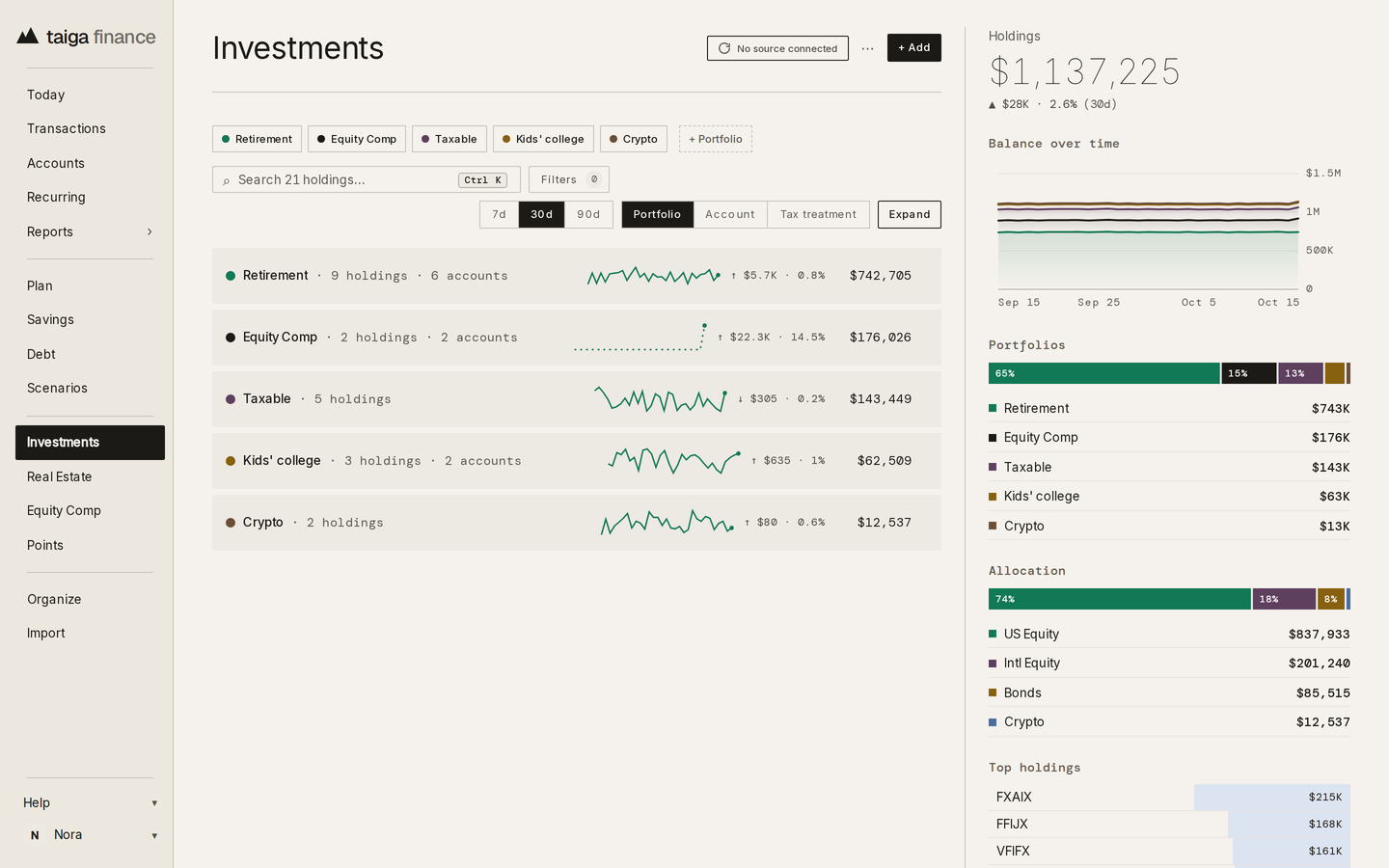
Taiga Finance shows no concentration figure and sets no threshold. Inside Investments, the rail's “Top holdings” list ranks the largest positions across accounts, each as a bar and a dollar value, with the rest as “Other”; clicking one narrows the ledger to that symbol. Owned shares from a grant, settled RSUs or ESPP purchases, are part of the total under the company's ticker, at the percentage of value the grant record is set to count.
There is no sector or employer figure. Owned equity sits in the ledger as the “Equity Comp” group, and a holding's row shows its weight as a percentage of its group, not of the whole.
Accounts & balances →Key takeaways: Concentration risk
- Concentration risk is exposure to one holding, sector or company that is a large share of a portfolio. The share, not the dollar amount, is the measure.
- The portfolio's move from that holding is the holding's move times its share: a 30% fall at a 40% share is a 12% fall in the whole.
- Equity compensation builds a concentrated position without a purchase, and the salary comes from the same company.
- Taiga Finance reports a single stock at 25% or more of the investments total as a line on Today, “NVDA is 38% of your portfolio”, and shows the six largest positions as “Top holdings” in Investments.
Questions about Concentration risk
What is concentration risk?
The exposure a portfolio has when a large share of its value is in one holding, one sector or one company. A move in that one thing moves the whole portfolio by the share it makes up: at 40% of the portfolio, a 30% fall in the stock is a 12% fall in the total.
How is a concentrated position measured?
As the position's value divided by the portfolio's total value, with the same stock in several accounts counted as one position. $100,000 of one company's stock in a $250,000 portfolio is a 40% position; the same $100,000 in a $1,000,000 portfolio is 10%.
Does Taiga Finance show concentration risk?
Not as a figure. The Investments rail lists the largest positions across accounts as Top holdings, each with its dollar value and the rest as Other, so one stock's weight can be read off it. There is no sector or employer figure and no threshold.