Discretionary spending
WantsDiscretionary spending is the spending a household chooses month by month, such as dining out, travel and shopping, as opposed to the fixed costs it is committed to. The discretionary pool is what take-home pay leaves after the fixed costs and the savings and investment lines are taken out.
What is discretionary spending?
A fixed cost is owed whether or not the month goes well: rent or a mortgage payment, insurance, a loan payment, a subscription until it is canceled. Discretionary spending has no bill behind it. The amount is decided during the month, one purchase at a time, and a month can pass with none.
The pool is worked by subtraction. Take-home pay, the amount deposited after taxes and payroll deductions, minus the fixed costs, minus what is set aside for investments and savings, is the discretionary pool. It is the same figure as the budget's variable spending lines added together, when the plan is built so that nothing is left over.
Where a line sits is the household's call. Groceries can be treated as a fixed cost by a household that spends the same amount every month, or as discretionary by one that trims it in a lean month. The 50/30/20 rule calls the discretionary share “wants” and puts it at 30% of take-home.
How discretionary spending works, with numbers
A household's take-home is $6,000 a month. Its fixed costs, the mortgage, utilities, insurance and a car payment, come to $3,200. The plan puts $600 toward investments and $300 toward savings. What is left, $1,900, is the discretionary pool, 31.7% of take-home.
The pool is then split across the variable lines: $550 for dining out, $400 for shopping, $400 for travel, $250 each for two people's fun money and $50 for a catch-all. A $200 cut to the car insurance premium raises the pool to $2,100 without touching any of those lines.
- Take-home
- $6,000
- Fixed costs
- − $3,200
- Investments
- − $600
- Savings
- − $300
- Discretionary pool
- $1,900
Why discretionary spending matters
The discretionary pool is the part of a month that can change. The fixed costs and the contributions are decided before the month starts, so a month that comes in over or under its total does so almost entirely in the discretionary lines, and that is where spent against planned has something to show.
The pool is also the amount that a change in fixed costs moves. A canceled subscription or a paid-off loan shows up as a larger pool, or as a larger contribution, without any variable line changing.
Discretionary spending in Taiga Finance
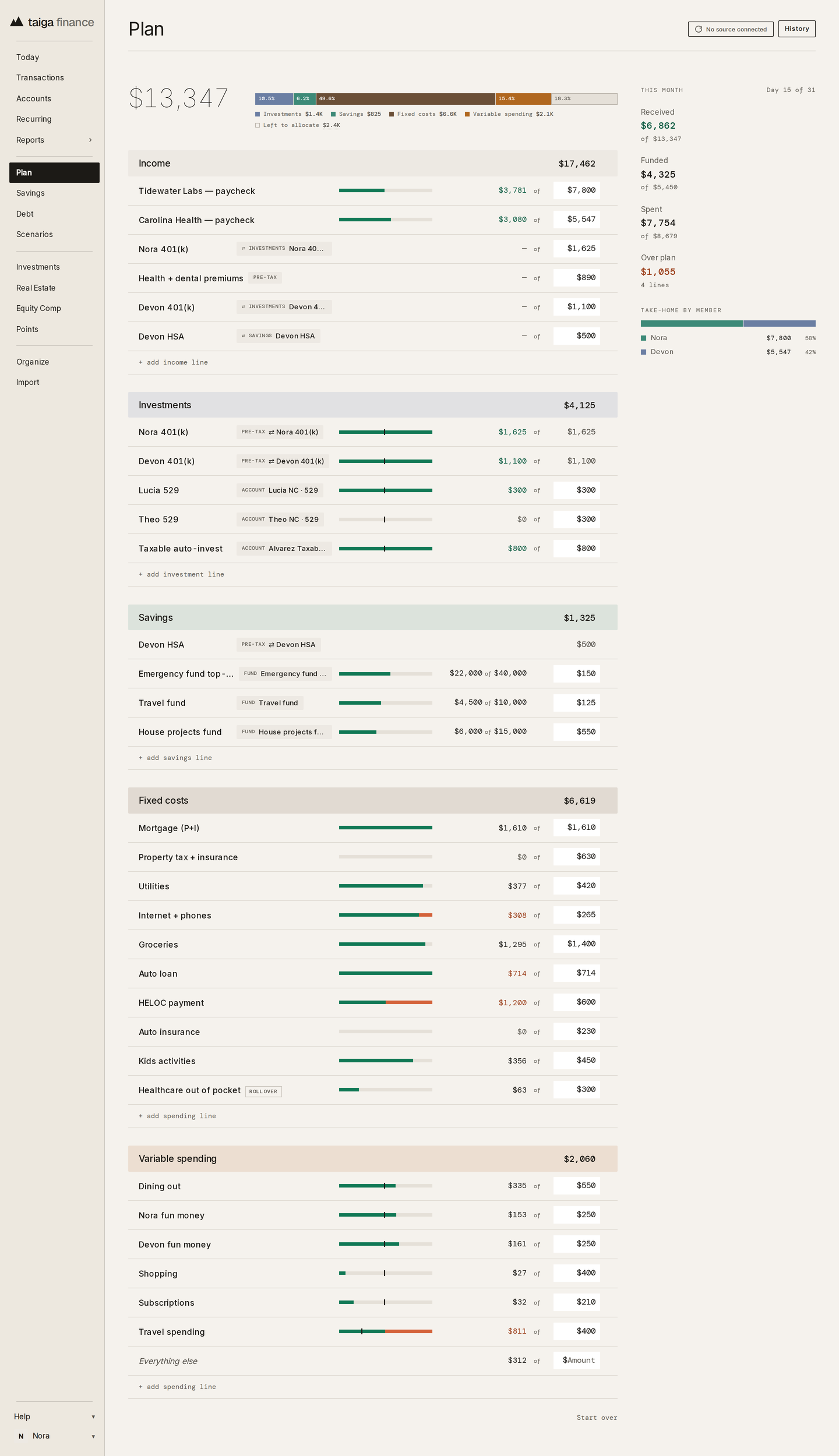
Taiga Finance has no figure named discretionary spending. The nearest reading is on the Plan: with fixed lines, Spending splits into “Fixed costs” and “Variable spending”, each line showing spent against planned as connected transactions land, and the catch-all “Everything else” at the foot of Variable spending. Which lines are fixed is the household's choice. The band at the top of the Plan draws Fixed costs and Variable spending as two segments of take-home, and the working behind its “Left to allocate” tail reads take-home minus everything planned.
Plan & goals →Key takeaways: Discretionary spending
- Discretionary spending is the spending decided during the month, with no bill behind it; a fixed cost is owed either way.
- The discretionary pool is take-home pay minus fixed costs, minus the investment and savings lines.
- Whether a line such as groceries is fixed or discretionary is the household's call.
- Taiga Finance has no discretionary figure; on the Plan, a plan with fixed lines splits Spending into Fixed costs and Variable spending, and the rail's Spending row counts both as one number.
Questions about Discretionary spending
What is discretionary spending?
Spending a household chooses month by month, such as dining out, travel and shopping, as opposed to fixed costs such as rent, insurance and loan payments that are owed whether or not the month goes well. The 50/30/20 rule calls it wants.
How is discretionary income calculated?
As a subtraction from take-home pay. Take-home minus the fixed costs, minus what goes to investments and savings, is the discretionary pool: $6,000 minus $3,200 in fixed costs, $600 in investments and $300 in savings leaves $1,900.
Does Taiga Finance track discretionary spending?
Not under that name. On the Plan, once the plan has fixed lines, Spending splits into Fixed costs and Variable spending, and the variable section holds the lines not added as fixed, ending in the Everything else catch-all. A line shows its spent figure against its planned amount.