Fixed vs variable expenses
Fixed and variable costsFixed expenses are the costs that arrive at a set amount on a schedule, whatever the month's choices: rent or a mortgage payment, insurance premiums, a loan payment, a subscription. Variable expenses are the costs whose amount depends on the month's choices: groceries, dining out, fuel, shopping.
What is fixed and variable expenses?
The split is by how much the amount moves month to month; a cost can be essential and still variable. Rent is fixed because the same figure is due on the same day. Groceries are variable because the total is set by what gets bought, though a household has to buy some. A utility bill sits between: it is due every month, at an amount that changes with the season.
Fixed expenses are known before the month begins, so they can be added up ahead of it. Variable expenses are known only as the month goes on. That is why the two piles are read differently against a budget: a fixed line either lands at its amount or it doesn't, while a variable line is watched through the month.
Which pile a cost belongs in is a judgment. A gym membership is a fixed amount that can be canceled; a car payment is fixed until the loan ends. A household draws the line where it finds it useful.
How fixed and variable expenses works, with numbers
A household's take-home is $6,000 a month. Its fixed costs are $1,800 in rent, $150 for car insurance, $120 for internet and phone and $30 in subscriptions, $2,100 in all. Its variable spending in one month is $700 on groceries, $300 dining out, $200 on fuel, $250 on shopping and $350 on everything else, $1,800 in all.
The fixed pile is $2,100 of a $6,000 take-home, so 35% of the month's take-home is committed before the month starts. The variable pile could have come in higher or lower; the fixed pile could not.
- Rent
- $1,800
- Car insurance
- + $150
- Internet and phone
- + $120
- Subscriptions
- + $30
- Fixed costs
- $2,100
- Take-home
- ÷ $6,000
- Share of take-home committed
- 35%
Why fixed and variable expenses matters
The fixed pile is what a month costs before any of its choices are made. Its share of take-home, 35% in the example, is the part of income already committed, and the rest is what the variable lines and the savings and investment lines are set from.
The two piles change in different ways. A variable line moves with the month's choices, so it can be lower next month. A fixed line moves only when the commitment behind it changes: a lease ends or a subscription is canceled. When the fixed pile grows, a larger part of every month is settled in advance.
Fixed vs variable expenses in Taiga Finance
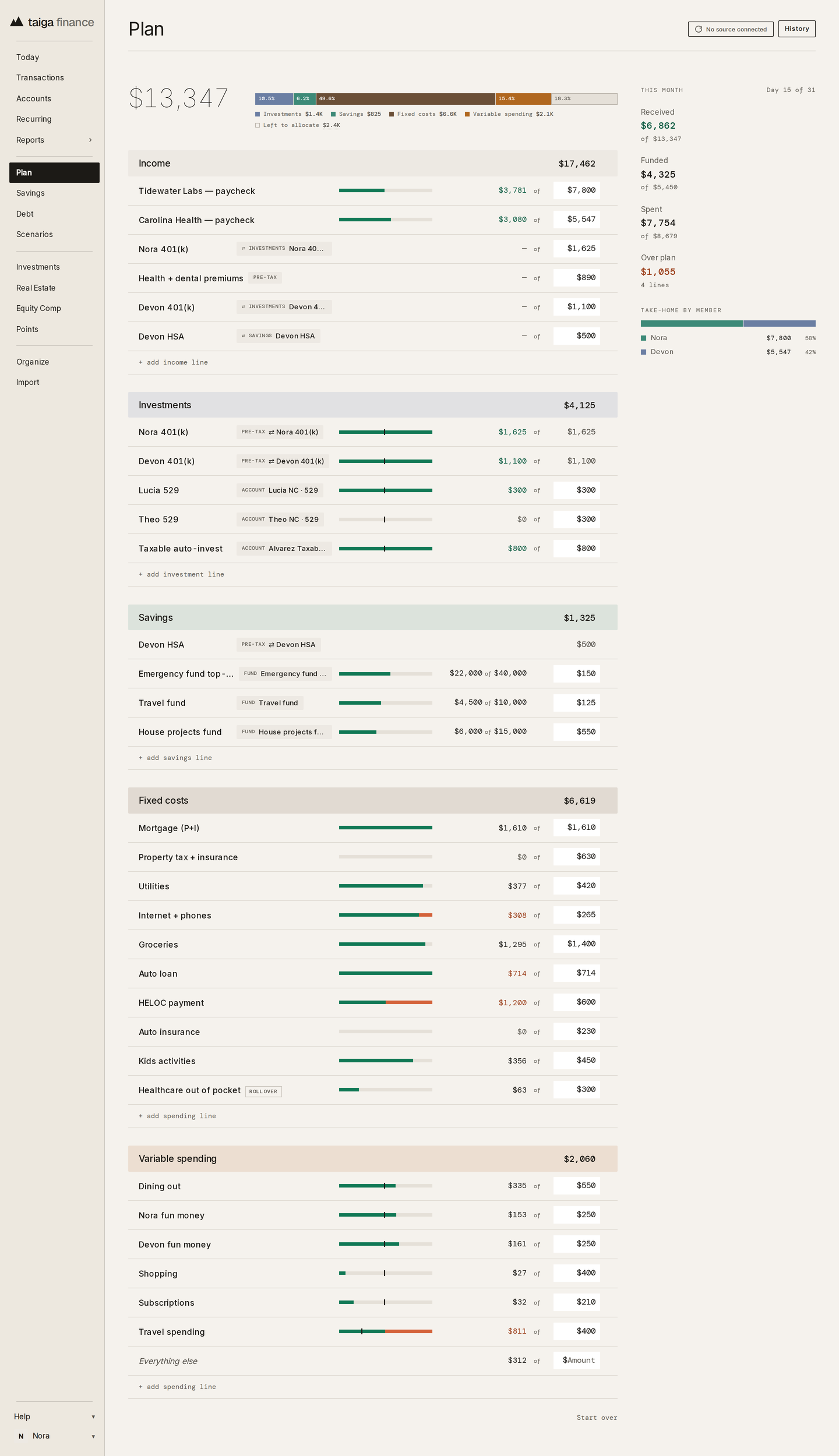
In Taiga Finance, a spending line on the Plan either belongs to the fixed group or it doesn't. When at least one line does, the Spending section renders as two sections, “Fixed costs” and “Variable spending”, each with the same row layout: the line's name, a meter, what has been spent and the planned amount, as “$1,610 of $1,610”. A line added from the Fixed costs section's add-line row joins the fixed group. The catch-all line, such as “Everything else”, sits in Variable spending. A line is fixed by belonging to that group; the app applies no rule to a category.
The band at the top of the Plan draws “Fixed costs” and “Variable spending” as two segments of take-home, each with its planned amount. The nearest figure to a committed share is on the Recurring page, whose “Of take-home” gauge shows the monthly recurring outflow it has found as a share of take-home, with the committed amount and the take-home behind it on hover.
Plan & goals →Key takeaways: Fixed vs variable expenses
- Fixed expenses arrive at a set amount on a schedule; variable expenses depend on the month's choices.
- Fixed costs can be added up before the month begins, and their share of take-home is the part of the month's income committed in advance.
- Which pile a cost belongs in is a judgment, drawn by how much its amount moves month to month.
- In Taiga Finance, the Plan shows spending lines under Fixed costs and Variable spending once a line belongs to the fixed group.
Questions about Fixed vs variable expenses
What is the difference between fixed and variable expenses?
A fixed expense is due at a set amount on a schedule, such as rent, an insurance premium or a loan payment. A variable expense has an amount set by the month's choices, such as groceries, dining out or fuel. The fixed pile is known before the month starts; the variable pile is known as the month goes on.
Are groceries a fixed or variable expense?
Variable, in the usual reading: the total depends on what gets bought, even though some grocery spending happens every month. A household that plans a set grocery amount can treat the line as fixed for its own purposes. In Taiga Finance, a Groceries line sits under Fixed costs or Variable spending according to which group it belongs to; the app does not decide from the category.
Does Taiga Finance separate fixed and variable expenses?
Yes, on the Plan. Once a spending line belongs to the fixed group, the Spending section splits into Fixed costs and Variable spending, with the same row layout in each. The rail still shows Spending as one figure with its share of take-home.