Extra principal payment
Prepayment · Paying extra on a loanAn extra principal payment is an amount paid on a loan above the scheduled payment and applied to the balance rather than to interest. The next month's interest is charged on the smaller balance, so the schedule ends sooner and the total interest is lower, while the scheduled payment itself stays where it was.
What is an extra principal payment?
A scheduled payment on an amortizing loan already covers the month's interest and retires a little principal. An extra amount on top of it has no interest left to cover, so the whole of it comes off the balance. From then on the interest each month is charged on a lower balance, a little more of the unchanged scheduled payment reaches principal, and the balance reaches zero before the last scheduled month.
The extra payment leaves the loan's terms alone. The rate, the maturity date on the note and the scheduled payment carry on; what moves is the month the balance runs out and the interest paid before then. A recast is the other way around: the servicer recomputes the payment on the lower balance and the loan runs to its original date. Some notes carry a prepayment penalty, which the loan's disclosures state.
A servicer decides how it applies an amount above the scheduled payment. One it holds as an advance on the next installment retires no extra principal; the payment form or the statement states how an amount is marked for principal.
How an extra principal payment works, with numbers
A $250,000 mortgage at 6.5% over 30 years has a payment of $1,580.17. In the first month the interest is $1,354.17 and $226.00 goes to principal. With $200 more paid each month and applied to principal, that first month retires $426.00 instead.
Kept up every month, the $200 clears the balance in 265 payments, 22 years and 1 month, against 360: 95 months sooner. The interest comes to $221,243 instead of $318,861, $97,618 less. The figures are this example's arithmetic, with the rate fixed and the extra paid every month.
- Balance
- $250,000
- Payment at 6.5%, 360 months
- $1,580.17
- Extra principal, each month
- + $200
- Payments to zero, no extra
- 360
- Payments to zero, with extra
- 265
- Interest, no extra
- $318,861
- Interest, with extra
- − $221,243
- Interest avoided
- $97,618
Why an extra principal payment matters
The extra payment moves the two figures a schedule ends on, the payoff date and the total interest, without touching the payment. In the example, $200 a month, about 13% on top of the scheduled payment, takes 95 months and $97,618 off a 360-month loan, because a dollar of principal paid early skips the interest it would have carried for the rest of the term.
A dollar paid to principal is a dollar of equity rather than cash on hand: the balance is lower, and the loan's schedule is what changed. The same dollar late in the term skips less interest, since it would have carried interest for fewer months.
Extra principal payment in Taiga Finance
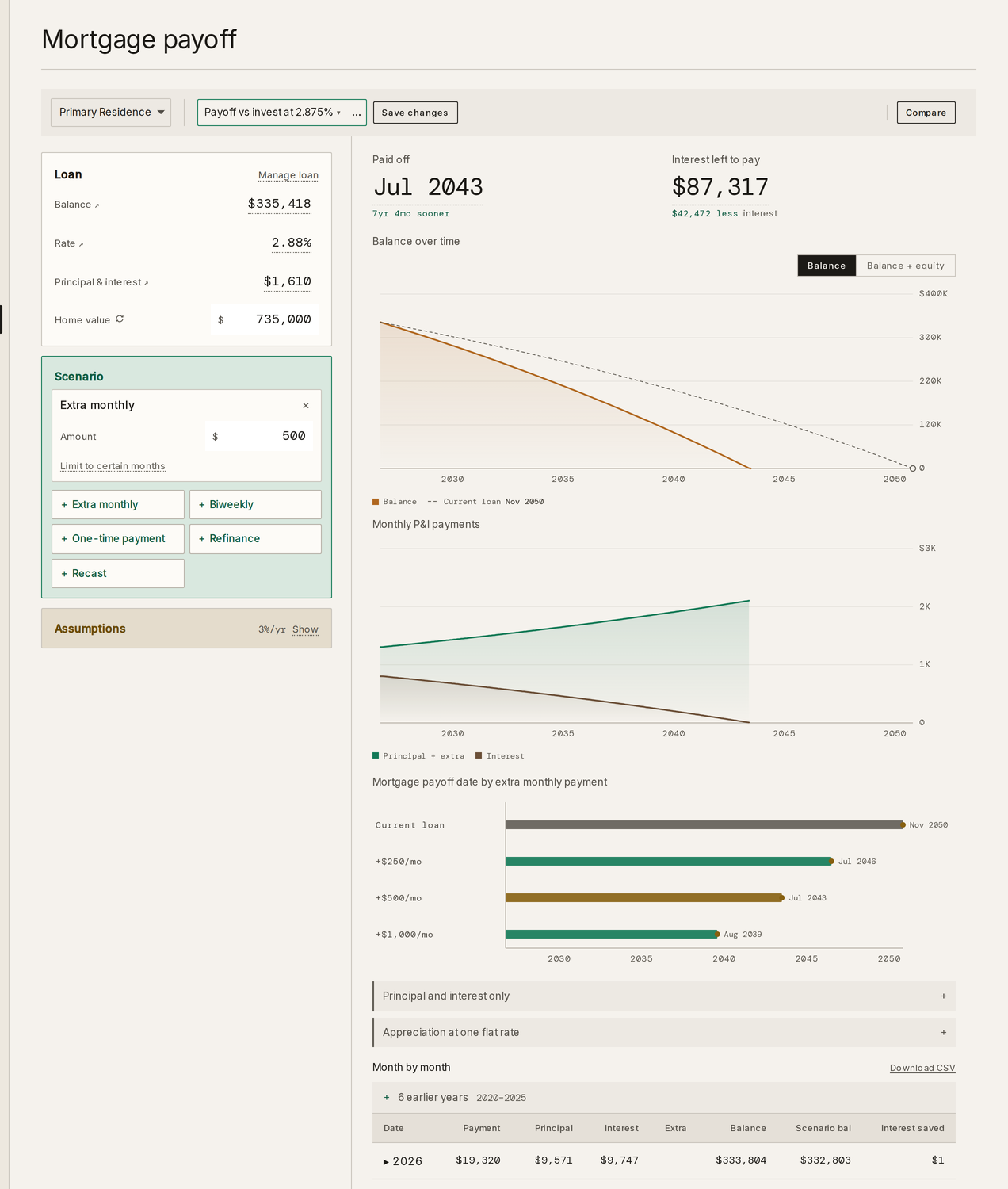
The mortgage payoff planner in Taiga Finance, under Scenarios and on the property's page, has an “Extra monthly” block with an “Amount” and, behind “Set a window”, a “From” and an “Until” date. Adding it moves “Paid off” and “Interest left to pay”, each with its change against the loan as it stands, and “Balance over time” draws the plan's balance beside the “Current loan”. “Monthly P&I payments” draws the plan's principal and interest parts month by month.
“Mortgage payoff date by extra monthly payment” lists the payoff date at a few larger monthly amounts, and the “Month by month” ledger lists the schedule, with a “Download CSV”. A one-time amount is its own block, “One-time payment”, with an “Amount” and an “On” date.
On the property's page, a mortgage with no linked account has a section that records each extra principal payment; a live-synced loan measures extra principal from its balance, and the section shows only what was recorded. The public calculator runs the same “Extra monthly” block on a balance, rate and term typed in without an account.
The public mortgage payoff calculator →Key takeaways: Extra principal payment
- An extra principal payment is an amount above the scheduled payment that comes whole off the balance, since the scheduled payment has already covered the month's interest.
- It shortens the schedule and lowers the total interest; the rate and the scheduled payment stay the same. A recast lowers the payment instead.
- In the example, $200 a month on a $250,000 loan at 6.5% takes 95 months and $97,618 of interest off a 30-year schedule.
- Taiga Finance's mortgage payoff planner has an “Extra monthly” block whose amount moves the “Paid off” and “Interest left to pay” readouts, each with its change against the loan as it stands.
Questions about Extra principal payment
What is an extra principal payment on a mortgage?
An amount paid above the scheduled payment and applied to the loan's balance. The scheduled payment has covered the month's interest, so the extra retires principal only, and the following months' interest is charged on the smaller balance. The payment, the rate and the note stay as they were; the payoff date moves earlier.
How much does paying an extra $200 a month on a mortgage save?
It depends on the balance, the rate and how far into the term the loan is. On a $250,000 loan at 6.5% over 30 years, $200 a month from the first payment clears the balance 95 months sooner and cuts the interest from $318,861 to $221,243. Taiga Finance's mortgage payoff planner works the same figures for a loan on file, as “Paid off” and “Interest left to pay”, each with its change against the loan as it stands.
Does an extra payment lower my monthly mortgage payment?
No. The scheduled payment stays the same and the loan ends sooner. Lowering the payment on the reduced balance is a recast, which the servicer does after a lump-sum principal payment and which keeps the original payoff date.