Loan term
Repayment term · Loan lengthA loan term is the number of months or years a loan is scheduled to run, from the first payment to the last. With the balance and the rate it fixes the level payment: the same balance at the same rate over a longer term gives a smaller payment and more interest in total.
What is a loan term?
The term is the third of the three numbers an installment loan is built on. The balance and the rate set what a month's interest costs; the term sets how many payments the balance is spread across. The standard formula turns the three into one level payment, and the amortization schedule follows from that payment.
A longer term lowers the payment, because the balance is divided over more months, and raises the total interest, because the balance stays out longer at the same rate. In the first month the interest is identical under either term; the two schedules part after that, as the shorter term's larger payment retires more principal and leaves less for the next month's interest to accrue on.
The term is set when the loan is made and does not change as the loan is paid; what changes is the time left on it. A loan paid ahead of schedule reaches zero before its term ends, and a refinance replaces the term with a new one.
How a loan term works, with numbers
A $20,000 loan at 7% APR is offered over 36 months or over 60. The monthly rate is 7% divided by 12, so the first month's interest is $116.67 under either term. Over 36 months the level payment is $617.54; over 60 it is $396.02, which is $221.52 a month less. The rate is fixed and the payments are made as scheduled; the figures here are this example's arithmetic.
The 36 payments come to $22,231.44, of which $2,231.44 is interest. The 60 payments come to $23,761.20, of which $3,761.20 is interest, so the longer term costs $1,529.76 more for the same $20,000.
- Balance
- $20,000
- Monthly rate (7% ÷ 12)
- 0.583%
- Payment, 36 months
- $617.54
- Payment, 60 months
- $396.02
- Interest over 36 months
- $2,231.44
- Interest over 60 months
- $3,761.20
- Extra interest on the longer term
- $1,529.76
Why a loan term matters
The term is what trades the monthly payment against the loan's total cost. In the example the 60-month term takes $221.52 less out of a month and adds $1,529.76 to what the loan costs over its life.
The term also sets the payoff date, and with it how long the balance sits among a household's liabilities. Two loans with the same balance and rate can carry different payoff dates for no reason other than their terms.
Loan term in Taiga Finance
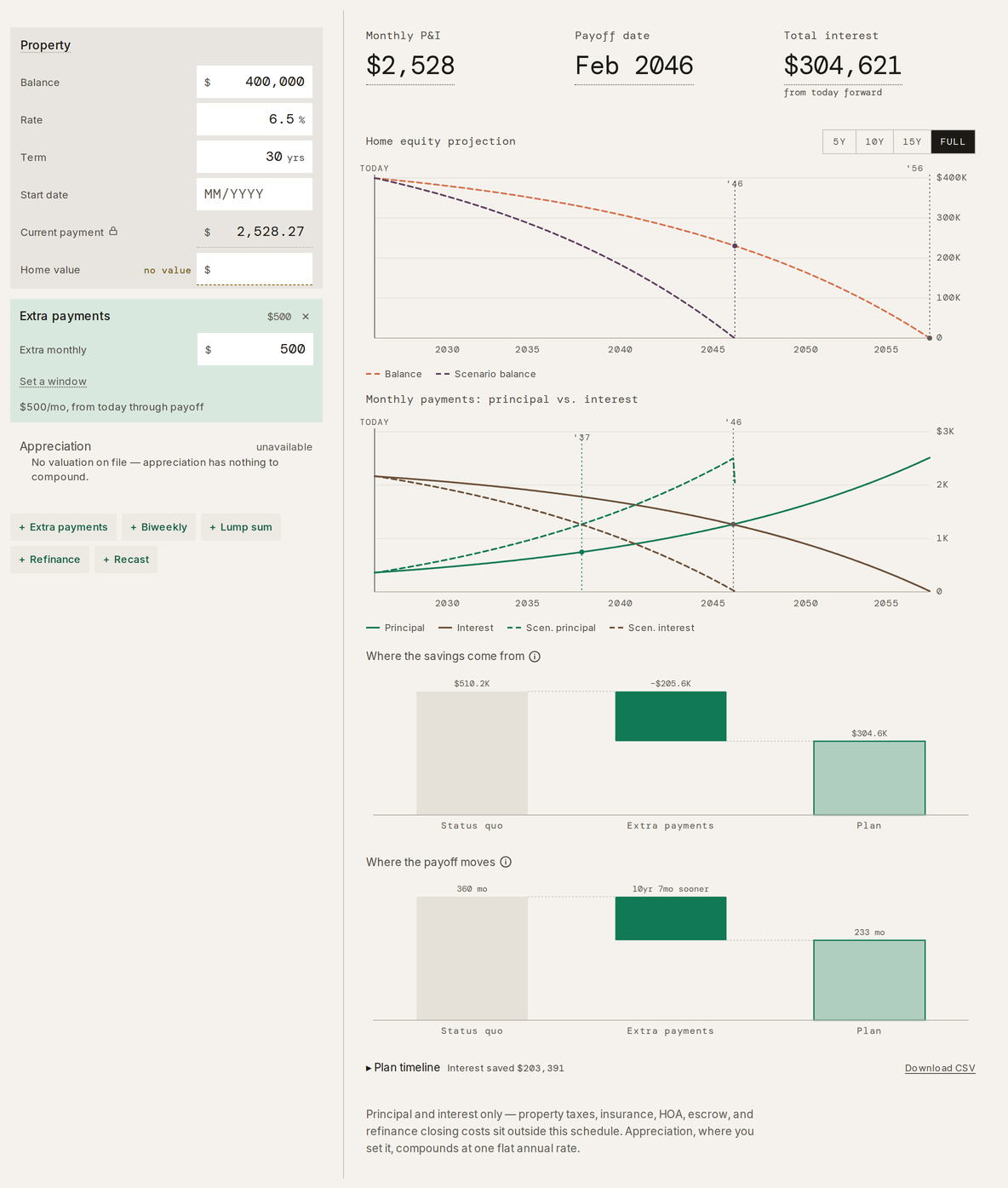
In Taiga Finance, the “Track a debt” drawer on the Debt page has a “Terms” section. For a non-revolving type, such as “Student Loan”, “Auto Loan” or “Personal Loan”, it takes an “Original balance ($)”, a “Term (months)” and an “Origination” month beside the “Current balance ($)”, “APR (%)” and “Minimum payment ($)” every debt has; a “Credit Card”, “HELOC” or “Buy-Now-Pay-Later” debt has no term field. Once the debt is tracked, its drawer's “Details” section edits the “APR” and the “Minimum”, and the payoff plan projects the debt from its balance, its rate and its minimum payment rather than from the term.
A mortgage carries its term on the loan record: the original principal, the rate, the term in months and the origination date, from which the scheduled monthly principal and interest follows. The property's loan card reads the term as years with the years left, such as “30yr · 17yr left”. On the public mortgage payoff calculator, “Term left” is typed in beside “Balance” and “Rate”. On a tracked loan the planner's “Term” is a locked fact read from the loan, with a door to the loan record.
The public mortgage payoff calculator →Key takeaways: Loan term
- A loan term is the number of months or years a loan is scheduled to run, from the first payment to the last.
- The balance, the rate and the term fix the level payment; a longer term means a smaller payment and more interest in total.
- In the example, $20,000 at 7% costs $2,231.44 in interest over 36 months and $3,761.20 over 60.
- Taiga Finance takes a term on a non-revolving debt and on a mortgage, builds a mortgage's scheduled payment from it, and projects a debt's payoff from its balance, rate and minimum rather than from the term.
Questions about Loan term
What is a loan term?
The length of time a loan is scheduled to run, stated in months or years. Together with the balance and the rate it fixes the level payment, and it sets the date the last scheduled payment falls on.
How does the loan term change the monthly payment and the total interest?
A longer term spreads the balance over more payments, so each is smaller, and keeps the balance out longer, so more interest accrues. A $20,000 loan at 7% is $617.54 a month over 36 months with $2,231.44 of interest, and $396.02 a month over 60 months with $3,761.20 of interest.
Where does Taiga Finance use a loan's term?
On a mortgage, where the “Add a loan” form fills in the scheduled monthly P&I from the original principal, the rate and the term, and the “Loan terms” band and the property's loan card show it. A non-revolving debt on the Debt page takes a “Term (months)” when it is added; its payoff projection runs on the balance, the rate and the minimum payment.