Irregular income
Variable incomeIrregular income is pay that changes from month to month, such as freelance, commission, tips or seasonal work, with no set amount to plan a month from. A plan for it is built from a baseline: one figure drawn from recent months, usually the lowest of them.
What is irregular income?
A salary lands in the same amount on the same schedule, so the month's take-home is known before it starts. Irregular income is known only after the month, and a run of months is the only record of what it tends to be.
A baseline stands in for the missing figure. The lowest-recent-month form takes the last several months and uses the smallest of them as the amount to plan against. An average of the same months is another form; the two can sit far apart when one month was much higher or lower than the rest.
The baseline moves with its window. As a new month lands and the oldest drops out, the lowest month in the window can change, and the baseline moves with it.
How irregular income works, with numbers
A freelancer's take-home over the last six months was $3,100, $2,900, $5,200, $4,400, $6,800 and $5,600. The six add to $28,000, so the average is $4,667; the lowest is $2,900.
With the lowest recent month as the baseline, the month's spending, savings and investment lines are set against $2,900. A month that brings in $5,600 lands $2,700 above the baseline, and in this method that amount is held for a month that comes in under it.
- Six-month average, $28,000 ÷ 6
- $4,667
- Lowest of the six, the baseline
- $2,900
- This month's take-home
- $5,600
- Baseline
- − $2,900
- Above the baseline
- $2,700
Why irregular income matters
A plan set against the average is short in the months below it: at $4,667 planned, the $2,900 month comes in $1,767 under the plan. A plan set against the lowest recent month is covered in all six months of the window, and the higher months leave a margin above it.
The choice of window matters as much as the choice of form. Over the last three of those months the lowest is $4,400, not $2,900, and the same method gives a baseline $1,500 higher.
Irregular income in Taiga Finance
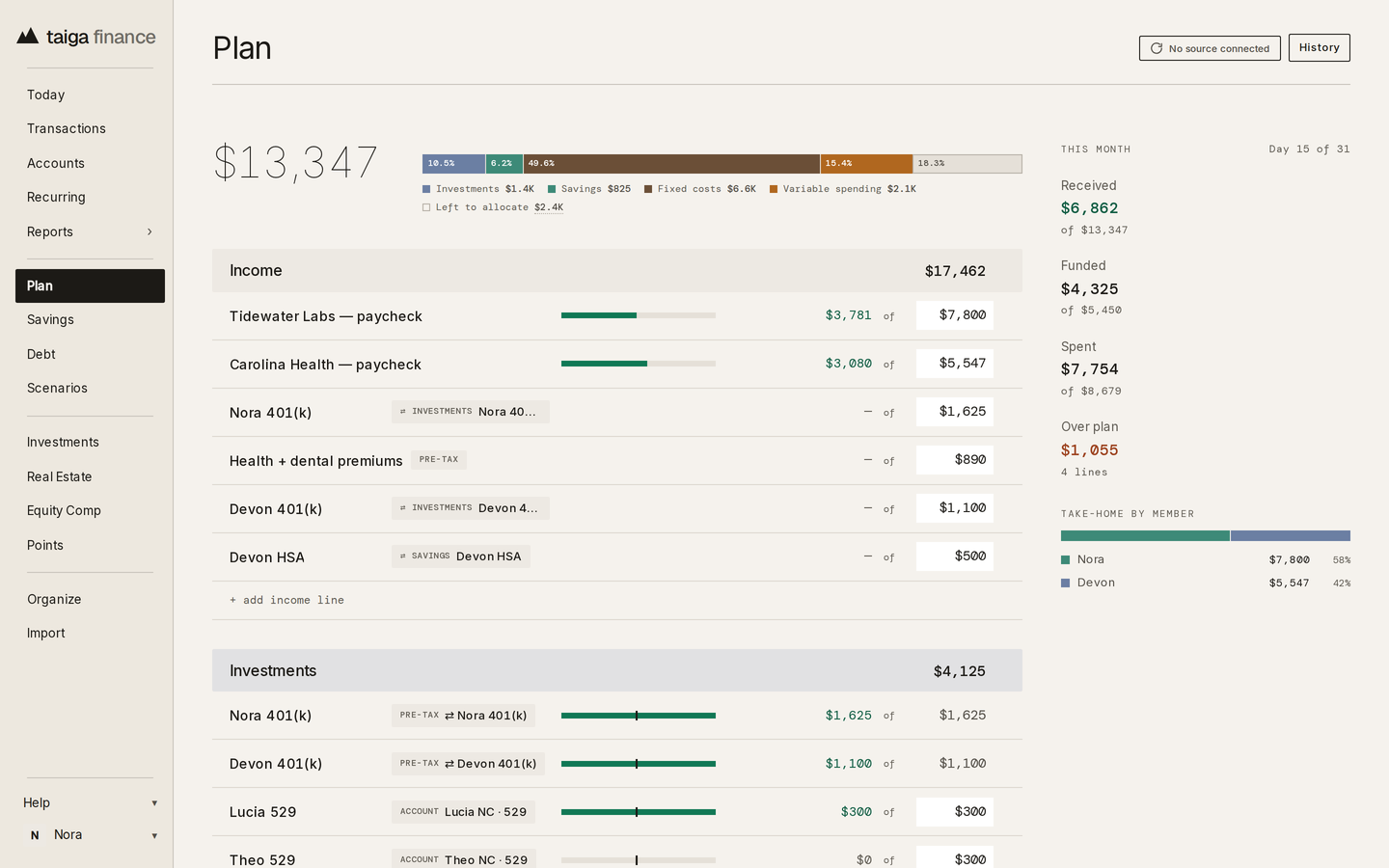
Taiga Finance has no irregular-income mode and computes no lowest-month baseline. A paycheck line on the Plan carries one monthly expected figure, and as connected deposits land the line's meter reads what has been received against it; the rail's “Received” row does the same across all income.
On Recurring, when the Plan has no take-home set, the “Of take-home” gauge divides by the recurring income it has found instead, and “Irregular” is the cadence band for a commitment with no fixed interval.
Plan & goals →Key takeaways: Irregular income
- Irregular income is pay that changes from month to month, with no set amount to plan a month from.
- A baseline is one figure drawn from recent months: usually the lowest of them, or their average; the two can sit far apart.
- A plan set against the lowest recent month is covered in each month of the window, and a higher month leaves the difference above the baseline.
- Taiga Finance has no irregular-income mode; its Plan take-home is a set monthly figure per paycheck line, read against what has landed.
Questions about Irregular income
What is irregular income?
Pay that changes from month to month, such as freelance, commission, tips or seasonal work, so the month's take-home is known only after the month. A plan for it works from a baseline drawn from recent months.
How is a budget set with irregular income?
In the common method, against a baseline: the lowest of the last several months, so the plan is covered in each month of the window, and the amount a higher month brings in above the baseline is held for a month that comes in under it. An average of the same months is another form of the baseline.
Does Taiga Finance handle irregular income?
It has no irregular-income mode and computes no lowest-month baseline. A paycheck line on the Plan carries one monthly figure, set by hand or drafted at setup from the average of the last three complete months of Income deposits, and reads what has landed against it through the month.